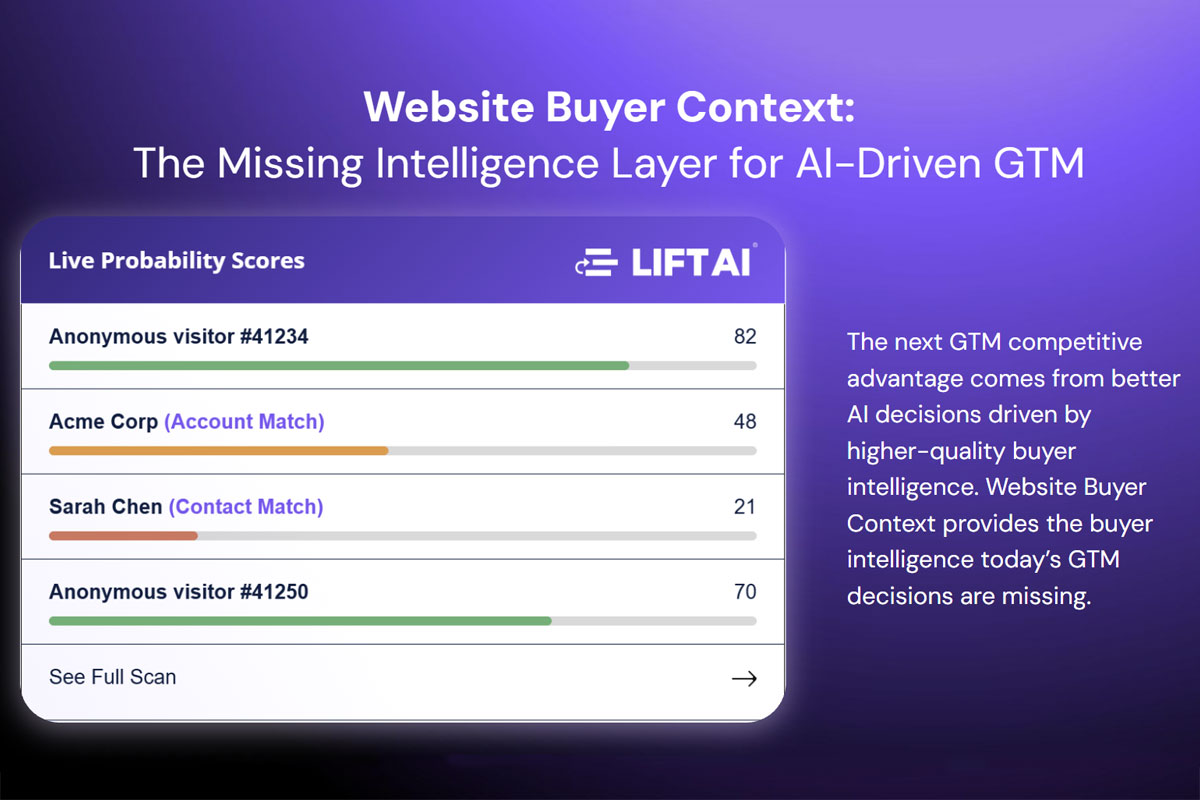

Buyer prediction isn’t a prompt problem — it’s an outcome-trained behavioral prediction problem. Lift AI predicts who’s likely to buy, explains why through the Buyer Context Brief, and gives LLMs and GTM agents the intelligence to act on it.
You can build a working CRM prototype with an LLM (Large Language Model) in a weekend. A landing page in an hour.
So why not point Claude or ChatGPT at your website traffic and ask it which visitors are going to buy?
Try it. Right now, in another tab.
Ask: “Can you access my website traffic and tell me which visitors are about to buy?”
You’ll get back something close to this:
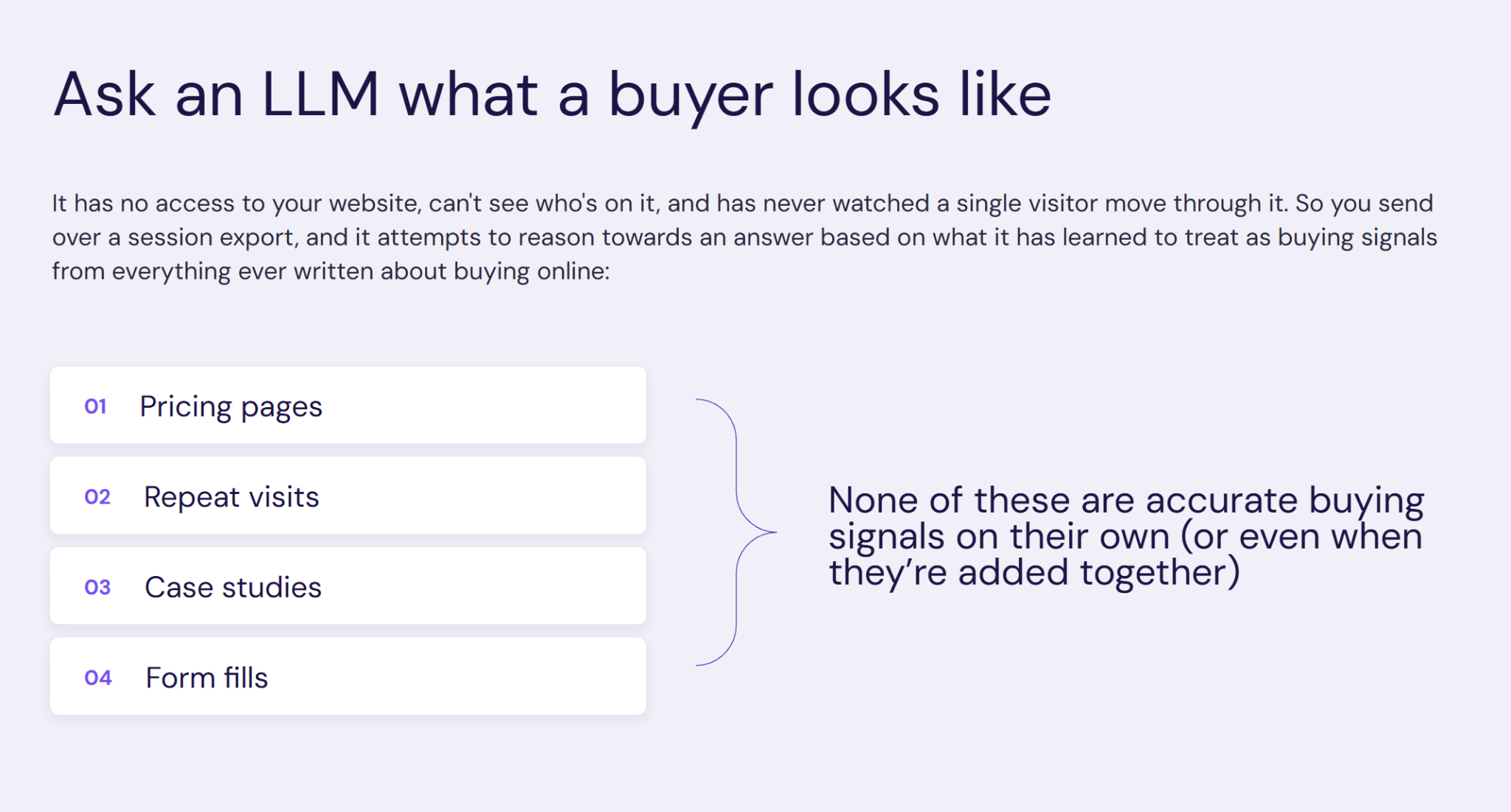
I don’t have access to your website traffic, so I can’t see who’s visiting your site or what they’re doing. You’d need to provide the session-level data. Generally, behaviours that suggest buying intent include:
- Repeat visits within a short period
- Time spent on your pricing page
- Views of case studies, documentation or comparison pages
- A whitepaper download or trial signup
Give me the data and I can help identify the visitors who appear most likely to be in-market.
Two important things just happened.
First, it was completely honest about what it can see: nothing, unless you hand it the data.
Second, it told you — with total confidence — what a buyer looks like.
The first part is solvable (to a degree). The second one is the bigger problem.
The Wrong Kind Of AI For Predicting Who Buys
LLMs like Claude and ChatGPT are called generative AI models. They are exceptionally good at understanding context, working with language and numbers, and reasoning from the information you give them.
So if you did hand one your website session data, how would it work out whether a visitor is likely to buy?
The obvious approaches aren’t as useful as they first appear.
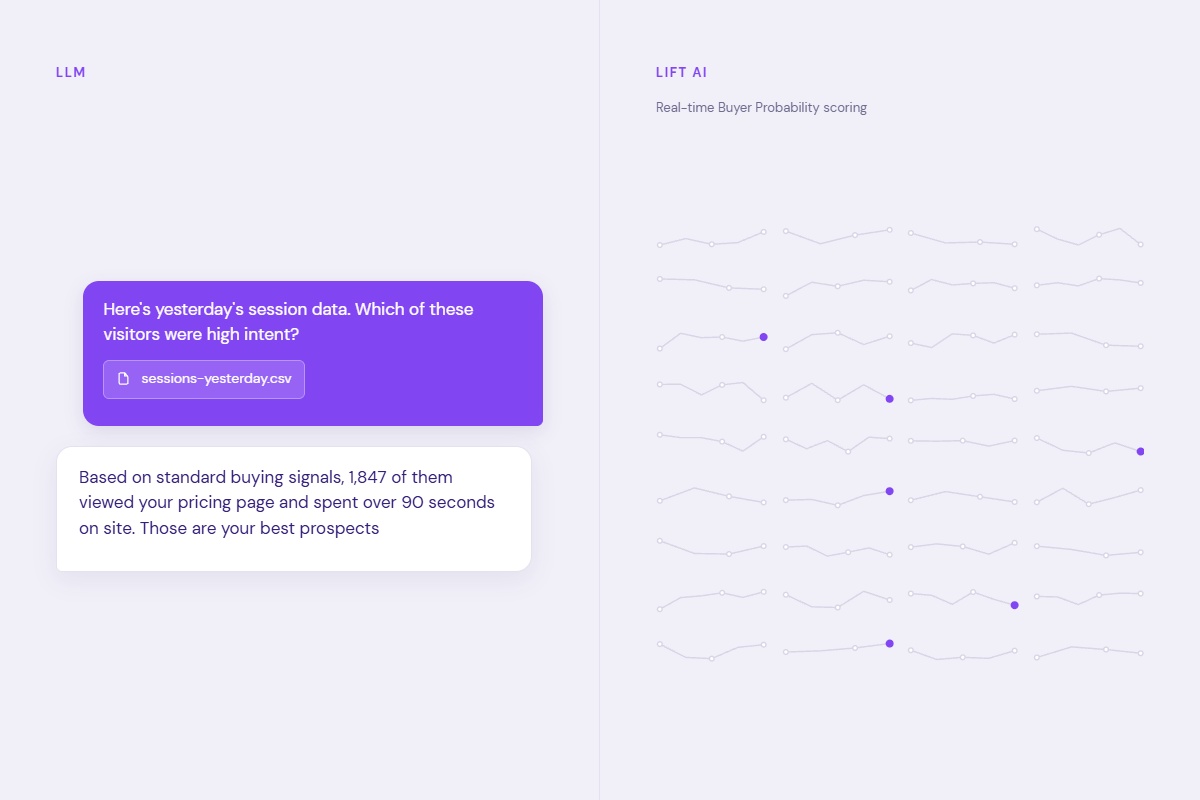
It uses whatever you tell it. Show it what you think buying looks like — visited the pricing page, more than 90 seconds on site, three or more pages in a session — and it will apply those rules literally to the visitors who resemble your examples.
Or it works them out for itself. Take your guidance away and it falls back on everything it has read about buying behaviour (which is probably the same as you have): the pricing page, the case study, the whitepaper download. It's the received wisdom of a million marketing articles.
Both routes land in the same place — a short list of plausible-sounding behaviours — and both inherit the same two problems.
The first is that the rules aren't reliable to begin with. Whether you wrote them or the model recited them, these high-level rules don’t accurately predict buying (something we’ll come back to soon).
The second is that real website behaviour doesn't stay tidy enough for static rules. Someone who does two of those three things, in a different order, a fortnight apart, is in neither your examples nor the received wisdom. So the model extrapolates what it knows and tries to apply these linear assumptions of non-linear behavior — confidently, and with no way for you to see how it got there.
There is a common objection here:
What if, instead of telling the LLM what you think high intent looks like, you give it real examples? This visitor converted. This one didn’t. Here is exactly what each of them did on the website. Surely the LLM can look at those examples and work out the pattern?
It can look for patterns. But that still isn’t the same thing as learning what predicts the outcome.
This is the important distinction between generative AI and predictive AI.
Give an LLM a thousand buyers and non-buyers in a prompt and ask it to judge intent itself, and it will read them, reason across them and produce its best judgement about what seems to separate the two groups.
But you’ll quickly run into the limitations of an LLM. The patterns might “all say people who fill forms are high intent because those forms must occur in the process before a purchase” — so the model will lean that direction. That’s called co-occurrence bias, and will result in a significantly flawed model.
A predictive model does something fundamentally different.
Those buyers and non-buyers become training data. The model’s entire job is to find whatever actually separates one outcome from the other. It tests different behaviours against the result. Then combinations of behaviours. Then different combinations again.
Does visiting the About Us page make someone more likely to buy? By how much? Does that change if it happens on a first visit versus a fifth? Does arriving at that page after the Comparison page matter? Does that behaviour still matter when dozens or hundreds of other behaviours are considered at the same time?
The predictive model doesn’t decide which explanation sounds plausible. It measures which patterns actually improve its ability to predict who buys.
Then it tests those patterns against visitors it was never trained on. If a pattern doesn’t continue to predict the outcome, it gets discounted or discarded.
That’s what makes this a predictive AI problem rather than a reasoning LLM problem.
An LLM can look at a group of buyers and tell you what they appear to have in common.
A predictive model can determine which of those similarities actually change the probability of someone buying — and which are just noise.
That’s a completely different job.
Can’t an LLM Infer Buying Intent from a Conversation?
A common thought is that LLMs can derive intent from a conversation. For example, most live chat tools today have an LLM-based AI component that can have conversations automatically. Why not let it qualify people in conversation, and infer intent from what they say?
The problem is that what people say and what people do are only loosely connected — and what they say tends to arrive late.
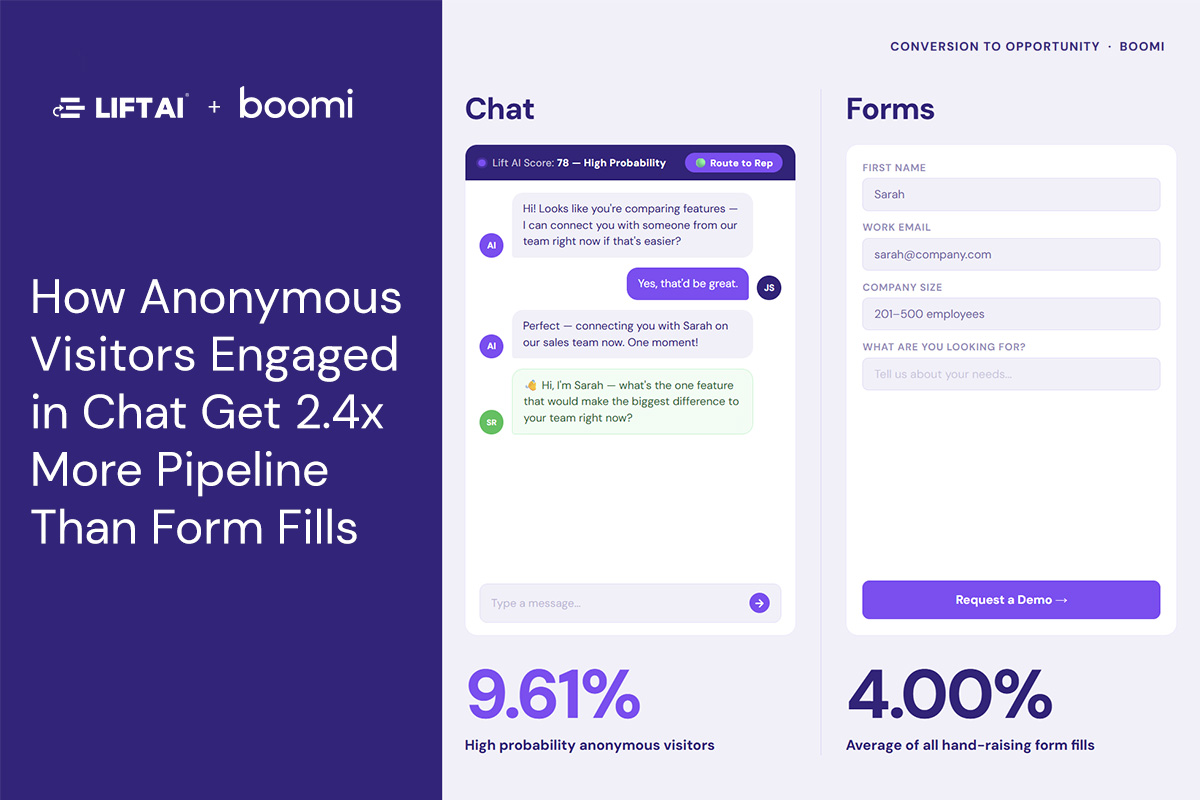
A form fill is the strongest verbal signal a visitor can send. They’ve typed their details and explicitly asked to be contacted by sales. But as many as 60% of them can have a low probability of buying (more on this later). If the most deliberate declaration of interest on your website is wrong more often than it’s right, a few lines of chat is weaker evidence still.
There are good reasons for that:
People downplay on purpose. “Just having a look” is what a serious buyer says to avoid being sold to. Meanwhile the person who says “we’re evaluating vendors this quarter” is often getting a third quote to meet their curation criteria.
Fluency isn’t readiness. The sharpest questions in your chat window come from competitors and analysts. A buyer with budget and authority might type four words and a question mark.
Most importantly — the conversation is the last thirty seconds of a much longer story. By the time someone opens chat, the behaviour that determined whether they’d buy has already happened — across sessions, over days, before they ever typed anything. The LLM is reading the footnote and trying to describe the whole journey.
What If You Ask The LLM To Build The Predictive Model Instead?
Claude Code can write code. ChatGPT Codex can write code. So instead of asking it to be the scoring model or to infer it from conversation, why not ask it to build one?
You absolutely can. Ask it to create a machine-learning model for scoring website sessions and it will produce working code remarkably quickly — recommending features, building the training pipeline, setting up evaluation. That part is no longer especially difficult.
Then it will ask you for the training data.
That’s where almost all of the value sits. The code is becoming a commodity. The hard part is having enough real-world history to teach a model what a buyer actually looks like.
What An LLM Thinks A Buyer Looks Like
Go back to the list an LLM gives you when you ask it to review buying behaviour. Pricing page views. Case studies. Repeat visits. Whitepaper downloads. Form fills.
Every LLM produces some version of that list, because it has read thousands of articles, playbooks and marketing posts saying those behaviours indicate buying intent. But repeating something often enough doesn’t make it predictive.
Lift AI’s outcome data — measured against who actually went on to buy, not against a model’s own label — shows that up to 94% of pricing-page visitors don’t show high buyer probability. More surprising still: 88% of visitors who are high-probability buyers never visit the pricing page at all. So using the pricing page visit as a key buying signal is going to result in wasted time and effort on pricing page visitors, while missing genuine buyers strewn across the remaining website pages.
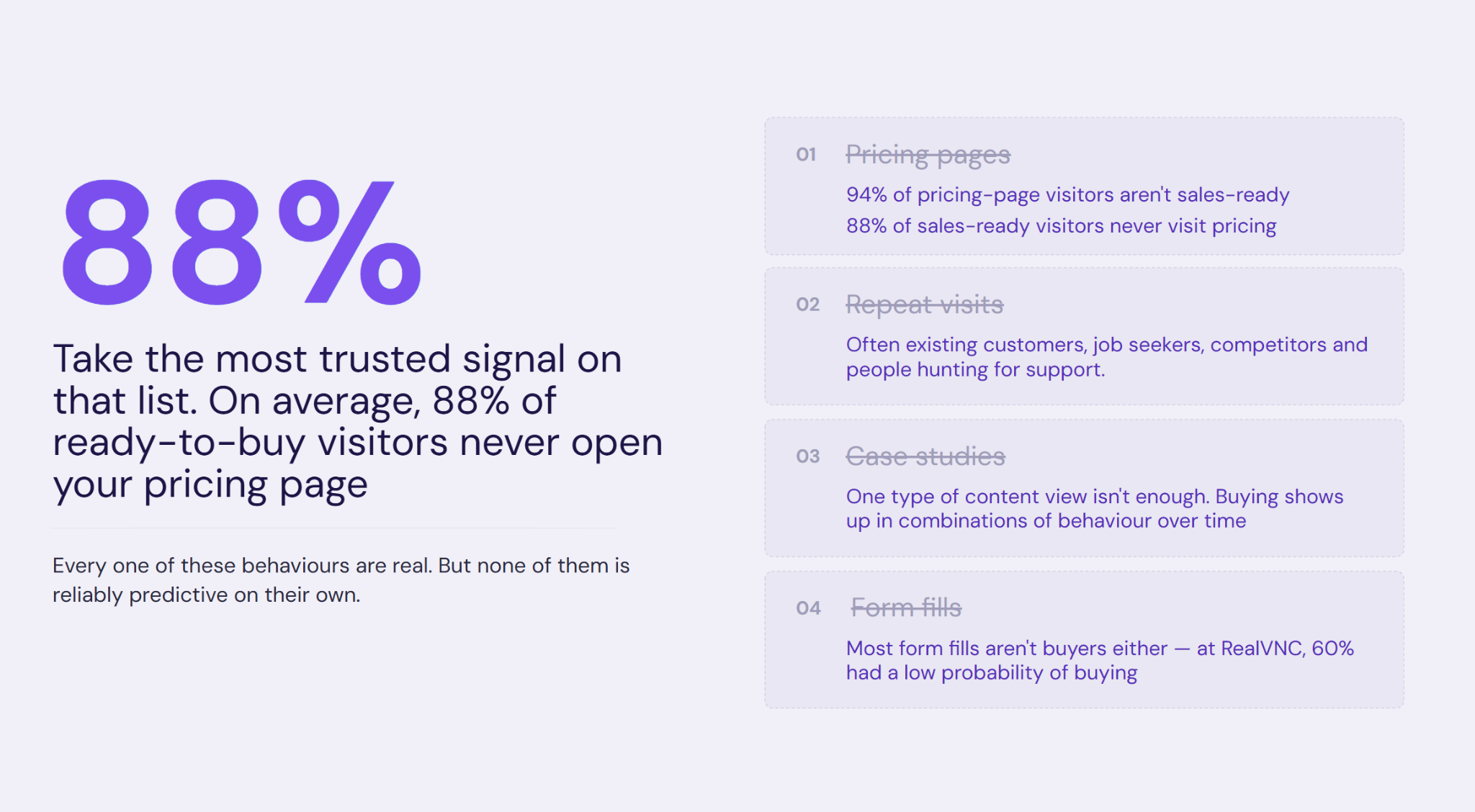
What about form fills? Lift AI data also shows that sometimes, the majority of form fills aren’t buyers either. In RealVNC’s case, 60% of form fills had a low probability of buying.
And even if you did pass an LLM the form fills that did buy, looking only at buyers tells you what buyers tend to do. It tells you nothing about whether that behaviour separates them from everybody else — and separation is the only thing a prediction can be built from.
The same is true for other one-dimensional signals. Views of the case study page. Repeat visits. Time on site. Looking at these in isolation can’t accurately predict a buyer, because buying behavior is far more nuanced and complex. Nor can they be added up in a linear A+B=C equation, for the same reason.
The LLM isn’t malfunctioning. It’s doing exactly what it’s built to do — reasoning from what humans have written down. It’s just that what marketers believe indicates buying and what has actually preceded purchases across millions of real outcomes are two different things.
The Training Data Is The Key To Everything
This is where “just train it on enough data” falls apart.
A billion website sessions are worth very little on their own. They tell you what people did. They don’t tell you whether any of it mattered.
What a model actually learns from is the outcome. Every visitor in the training data has to arrive with a verdict attached — this one became a customer, this one didn’t. That verdict is what turns a record of activity into something a model can learn from, and it’s the scarce ingredient here. Behaviour is easy to collect. Outcomes are not.
It’s also the part you can’t shortcut. You can generate synthetic visitor journeys. You can ask an LLM to invent thousands of plausible buyers. You can assume someone was interested because they filled in a form. What you cannot manufacture is the fact that a real person went on to spend real money. A plausible outcome isn’t an answer. Only the real one is.
“But We Have Years Of Our Own Sales Data…”
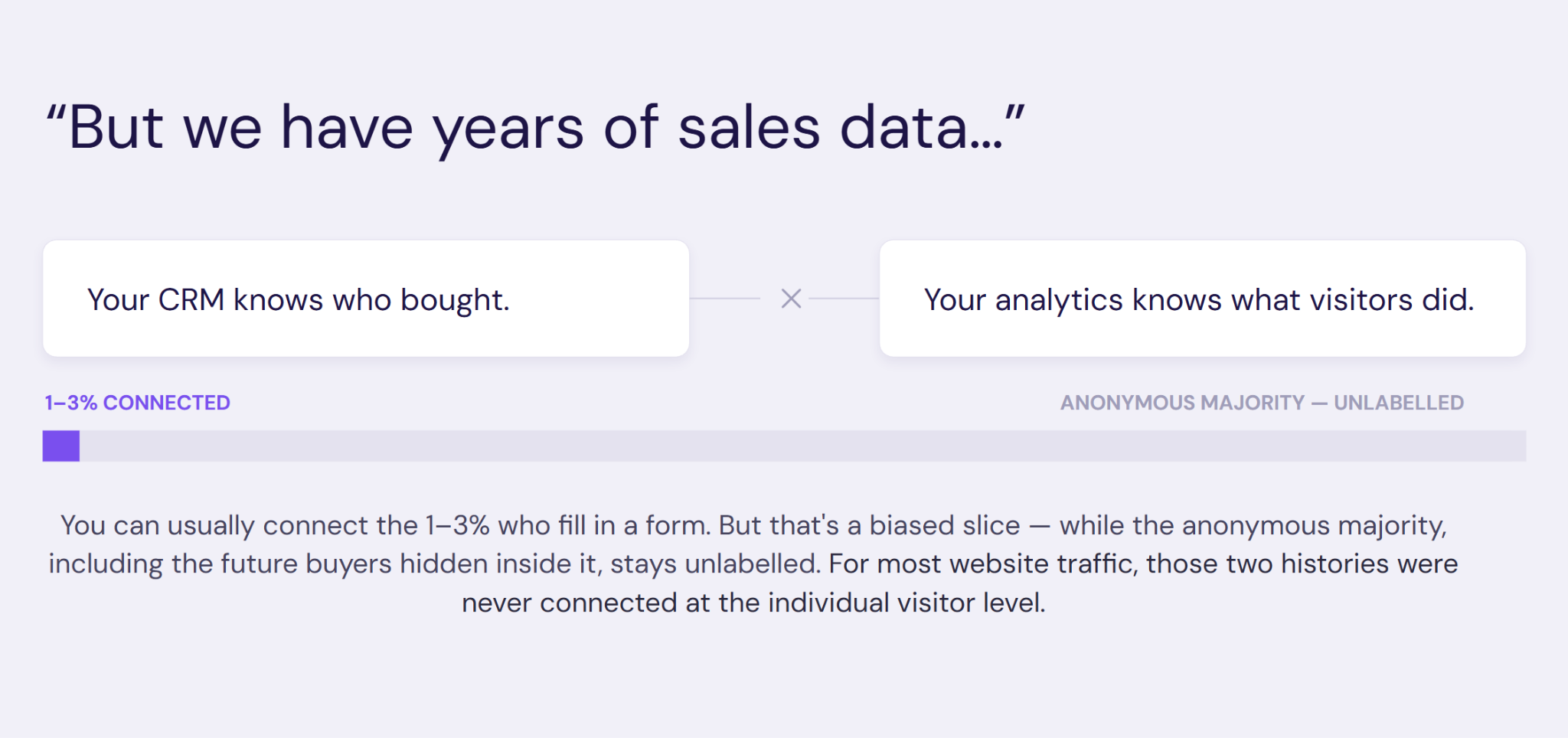
Here’s the problem. Your CRM knows who bought. Your analytics knows some of what visitors did (but they typically don’t track every available metric). The problem is that, for most of your website traffic, those two histories were never connected at the individual visitor level.
For someone who fills in a form, you can usually join some of the website visit to what happened later in the CRM (and even still, this is usually surface-level data like pricing page views). But now you’ve introduced a different problem: your training data is built around the small group of people who chose to identify themselves.
That’s already a biased sample.
Form fills represent only around 1–3% of total website traffic, and filling in a form isn’t necessarily a strong buying signal anyway. As mentioned, in RealVNC’s data, the majority of form fills had a low probability of buying.
So even if you know which of those form fills eventually became customers, you’re still missing the detailed behavioural history of the anonymous majority — including the future buyers hidden inside it.
And that’s the broader point: having a lot of data isn’t enough. It has to be the right data.
You need real purchase outcomes, not proxies like form fills or MQL status.
You need buyers and non-buyers across the full visitor population, not just the people who raised their hands.
You need enough different buying journeys — across customer types, products, industries and channels — that the model doesn’t mistake one narrow pattern for a universal one.
And you need enough history to know those patterns survive different seasons, markets and economic conditions rather than simply describing one moment in time.
A huge dataset can still produce a poor prediction model if any of those pieces are missing.
Which brings us to the part that is hardest to replicate.
Lift AI didn’t simply start with more data. It spent fifteen years accumulating this particular kind of data.
How Lift AI’s Unique Dataset Was Made
Lift AI didn’t begin as a software company trying to manufacture a score.
It began inside a commission-only sales agency, paid on the incremental revenue it generated for clients over 15 years. That created an unusually unforgiving feedback loop: if Lift AI’s sales team had a chat conversation with a website visitor that turned into a sale, it had to be proven. The client would check whether the revenue had actually happened and could be attributed to Lift AI’s involvement before paying the invoice.
Fifteen years of that produced billions of behavioural observations and millions of purchase outcomes — buyers and non-buyers alike — tied back to what those visitors did before the result was known. This was across B2B, B2C, and a wide range of industries and verticals.
It’s also what makes Lift AI’s Website Buyer Probability Score testable rather than merely confident. Lift AI grades above 85% accuracy on a customer’s traffic, against that customer’s real outcomes. Because the vast majority of visitors never buy, raw “accuracy” on its own would be a misleading measure — a model that simply predicted “no one buys” would look almost perfect. This figure reflects how well the score separates the buyers from the non-buyers on real, confirmed conversions — its lift over the base rate — not the share of visitors it labels correctly.
You can’t prompt an LLM into possessing that dataset, and you can’t scrape it from the internet. It can only be accumulated by observing behaviour and then waiting to find out what actually happened at the right scale, volume, scope, and outcome scrutiny.
And The Model Still Has To Work In The Real World
Three further requirements decide whether any of this is usable.
It has to see everyone. Roughly 70% of website traffic is anonymous, and only 1–3% of visitors ever fill in a form or start a conversation. An LLM inside a chatbot can be an extraordinary salesperson once someone begins talking to it — but it knows almost nothing about them prior to that conversation, nor about the overwhelming majority of visitors who never say a word to begin with. Lift AI scores the visitor whether they identify themselves or not, whether they chat or not, which matters because the most valuable person on your website may never raise their hand. Acting on that score still runs through the surfaces you already operate — chat, web experiences, routing, audiences — which is precisely where a scoring layer and an execution platform fit together: one decides who matters, the other does something about it.
It has to happen instantly. The score has to exist while the visitor is still on the site, so it can change what happens next: who sales prioritises, who sees a different experience, who gets routed into chat, who enters an audience. Lift AI updates a Website Buyer Probability Score in real time as behaviour unfolds — in milliseconds, before the next page loads. An LLM call can't hit that bar. Even a fast model takes hundreds of milliseconds to several seconds to return an answer, which is orders of magnitude too slow to act on before the visitor's next click. You can shorten a prompt or pick a smaller model, but you can't make generative reasoning finish inside the window a page render gives you. It isn't the wrong architecture for the job so much as too slow to be in the loop at all.
It has to be affordable at scale. Scoring isn't a question you ask once. It's a decision you re-make on every page, for every visitor. A mid-sized B2B site doing 200,000 sessions a month at five pages a session is a million scoring decisions a month — and the LLM version of that is a million API calls, each one carrying the visitor's session history in the prompt, each one getting more expensive as the session gets longer and there's more history to re-read. None of it caches, because no two visitor journeys are identical. And the overwhelming majority of that spend goes on visitors who were never going to buy. A purpose-built predictive model doesn't have that problem. Inference cost per visitor is fractional and flat, whether you're scoring a thousand people a month or ten million.
How Lift AI Works
Under the hood, Lift AI’s current production scoring model is a proprietary Random Forest classifier evaluating hundreds of engineered behavioural features from each visitor’s journey — page sequence, dwell time, revisit velocity, exploration-versus-evaluation patterns, and more. It’s an architecture well suited to real-time inference on structured behavioural data: fast, stable, and deployable at scale across every visitor on the site. An LLM can help explain or act on that output, but it isn’t the scoring engine.
The model is trained on validated purchase outcomes rather than proxies, and it scores anonymous and known visitors alike, in real time. Lift AI quantifies a visitor’s Website Buyer Context as a real-time 0–100 Buyer Probability Score and produces a Buyer Context Brief that makes the prediction usable: a Buyer Profile (which of 16 named archetypes the visitor resembles), the Areas of Focus (the products and topics they engaged with, ranked by attention), the Behavioural Trace (the evidence behind the score), and a Recommended Action. The score answers who to prioritise; the brief answers how to engage them.
So Could You Build Lift AI With an LLM Like Claude or ChatGPT?
Claude could write the code. ChatGPT could help design the pipeline. Either could analyse results, build dashboards, explain predictions or draft the outreach that follows.
What neither can give you is the thing the model has to learn from. To get there you would need years of anonymous behavioural history tied to confirmed outcomes — buyers and non-buyers — across enough segments and enough market cycles for the genuinely predictive patterns to separate themselves from the coincidental ones.
It’s worth being precise about why this is hard to replicate — even for a large platform already sitting on millions of sessions and conversion events. Volume isn’t the constraint. The constraint is having anonymous, individual-level behavioural history tied to revenue-verified outcomes — not form fills or MQL status — across many customer types and market cycles, with each label proven against money that actually changed hands. Booked-meeting counts and pipeline stages accumulate quickly; that particular kind of causally-verified, whole-population outcome data does not. It’s the difference between knowing what happened next in your funnel and knowing whether the behaviour caused it — and only the second one trains a model that predicts.
And that’s the part worth being clear about, because none of this makes LLMs less extraordinary. Accurate predictions can make LLMs more useful in their respective outputs.
For example, once you know a visitor has a high probability of buying, an LLM being used inside your tech stack can decide what to say to them — personalise the chat conversation, draft the email outreach, summarise the account, and so on.
Using Lift AI scores inside of Chat, Boomi increased Chat revenue by 23.4x — mostly from anonymous visitors that had no other actionable intelligence other than being scored by Lift AI before the Chat conversation was initiated.
You might also use an LLM to access Lift AI data, either directly or from an integrated tool. For example, if you have an MCP connection with HubSpot which is storing Lift AI scores against known accounts and contacts, you might ask the LLM “Which of my accounts showed a high probability of buying on our website today?”
That’s where the two technologies fit together.
LLMs are extraordinary once they have the right prediction to work from. They can explain the score, personalize the conversation, draft the outreach, summarize the account, or recommend the next action. But they should not be asked to guess buyer probability from generic marketing assumptions. That is the job of an outcome-trained behavioral prediction model.
Now Point Lift AI Website Buyer Context At The Whole Stack — Not Just The Chat Window
It’s clear what an LLM can’t do: score visitor behaviour, build the model without the training data, or work out who’s likely to buy from the small fraction of visitors who start a conversation.
But using Lift AI’s Website Buyer Context inside a conversational LLM (such as a Chat tool) is a perfect example of the score feeding a downstream system to increase conversions, pipeline, and revenue.
And Chat is not where it starts and ends. The GTM world is quickly reorganizing around AI agents that don’t just talk — they route leads, prioritize follow-ups, build ad audiences, personalize pages, enrich accounts, and decide where budget goes.
The biggest platforms are already saying as much.
Salesforce made Claude the default reasoning model across Agentforce — the Atlas Reasoning Engine, Agentforce Coworker, Agentforce Vibes — and across Slack. In the other direction, Salesforce became a plugin inside Claude, shipping with 37 prebuilt skills, so an agent can reason over live CRM data, update pipeline, and take governed action. It’s connected through MCP, it inherits the user’s existing permissions, and for regulated industries it runs inside Salesforce’s own trust boundary. “The #1 AI meets the #1 AI CRM,” as they put it.
And it still can’t tell you who’s going to buy.
Not because the reasoning is weak — it’s extraordinary. But because every field in Customer 360 is identity, activity or history: who someone is, what account they belong to, what they did, what they said. None of it was ever trained against who actually spent money. So the Atlas Reasoning Engine can reason flawlessly over a pricing-page visit — the very signal this piece has already shown to be mostly noise — and still miss the buyer who never went near the pricing page. Point the most capable agent stack ever built at the wrong readiness signal, and it acts on the wrong visitors: confidently, instantly, at scale.
This is exactly the layer Claudeforce doesn’t ship, and exactly the one Lift AI adds. Ask it, in Claude or in Slack, “which accounts showed a high probability of buying on our website today?” and the answer is grounded in a real, outcome-trained prediction rather than an activity guess. Claudeforce decides what to do. Lift AI tells it who’s actually worth doing it for.
The same is true for HubSpot. Launching its Agentic Customer Platform, HubSpot argues that the real AI race “isn’t about models or data — it’s about context,” and that “context is not a feature; it is necessary infrastructure.” We agree. The only question is which context — and the context every agent is still missing is individual Website Buyer Context.
The Future of LLMs is Agentic, Where Lift AI’s Website Buyer Context is More Important Than Ever
It’s clear that the GTM market is going agentic, and the vast majority of agents leverage LLMs to operate. And when you look at the anatomy of an agent, whether it’s inside of SalesForce or HubSpot, it’s worth knowing how they work and where the value is moving:
- CONTEXT / GRAPH — What does the agent know? The context graph connects identity, account, CRM history, conversations, behaviour and relationships into a usable picture of the customer — and, with Lift AI, adds predicted buyer readiness.
- ORCHESTRATION / HARNESS — What can the agent do? The harness determines which tools the agent can use, which actions it can take, what rules and permissions govern those actions, and how it uses context when deciding what to do.
- FEEDBACK / LOOP — Did the decision work? The feedback loop captures what happened after the action — conversation, opportunity, pipeline, revenue — so decisions can be evaluated and the systems making them can improve over time.
As we’ve seen, most context / graph layers are full of identity and activity — company, title, page views, form fills. They can tell an agent what happened. But even used all together, they cannot tell it who’s actually ready to buy, because nothing in them was ever trained against real purchase outcomes. They store behavior; they don’t interpret it.
The orchestration / harness layer gates actions on that same activity. “Visited the pricing page and is an identified account with ICP fit → route to sales.” But you already know how that ends — up to 94% of pricing-page visitors don’t show high buyer probability, and 88% of the people who do never visit pricing at all. Gate on activity and the agent acts confidently on the wrong visitors, at machine speed.
And the feedback loop can only measure what it can see. If the input was activity, all it can prove is that activity happened. It can’t tell you whether acting on a real prediction of buyer readiness produced more revenue — because there was no real prediction in the system to measure against.
All three parts of the agent stack have the same thing missing: a trustworthy, individual-level prediction of who’s likely to buy. Not a signal. Not an account guess. Not an LLM’s best impression of what a buyer looks like. An outcome-trained probability — the exact thing the earlier part of this piece explained an LLM can’t produce on its own.
You don’t need to replace the harness, the graph, or the loop. They’re fine at what they do. Instead, add the missing layer — put Lift AI Website Buyer Context in the graph, and the agent reads readiness instead of history. Put it in the harness, and the agent acts on who’s likely to buy instead of who clicked. Put it in the loop, and you can finally measure whether acting on readiness produced revenue — and let the real outcomes retrain the score.
- Better agents need better predictions — not just more context.
- Lift AI adds the missing prediction — who’s likely to buy — from your website behaviour.
- Better predictions create better decisions.
- Better outcomes tell you whether those decisions were right.
- Agentic performance scales accordingly across the stack.
Lift AI is an intelligence layer that scales across the entire GTM stack. The Buyer Probability Score predicts who’s likely to buy. The Buyer Context Brief explains why. The agent — inside its harness, reading its graph, closing its loop — decides what to do next.
Generative AI like LLMS decide what to say. Agentic AI decides what to do. Lift AI tells both who’s actually likely to buy — so every word and every action is aimed at revenue, not activity.