
Most GTM Teams Have No Idea This Is Possible
Form fills are often treated as the moment that matters most. It is the handoff point between marketing and sales, the trigger for routing logic, the signal that separates a "lead" from a "visitor."
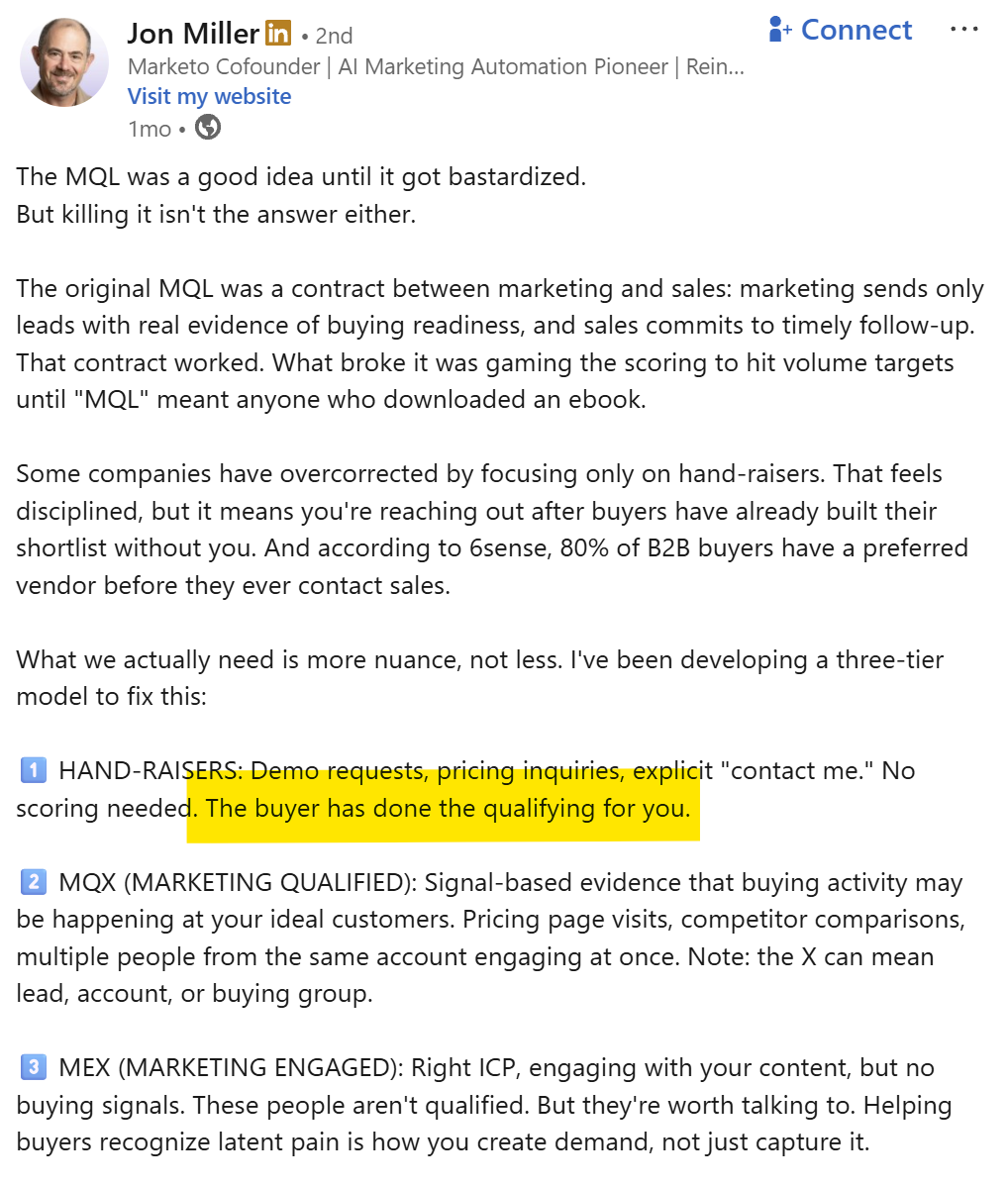
A couple of weeks ago, we pointed to Jon Miller's (Marketo co-founder and a foundational voice in B2B marketing) article that suggested hand-raisers sit at the top of the qualification hierarchy because "the buyer has done the qualifying for you." It's a view most GTM teams would agree with.
But the data we shared from our HubSpot, Salesforce, and Marketo integrations told a more nuanced story — where the gap in form conversion rates between high, mid, and low probability visitors reveal new ways to optimize GTM activation of form fills.
But in the process, we realized that most teams still have left one of the highest-converting channels in their GTM stack vastly underutilised. Not abandoned. Not broken. Just untapped.
Because Chat and Conversational AI, when backed by accurate buyer probability scores, are producing results that challenge some of the most deeply held assumptions in GTM.
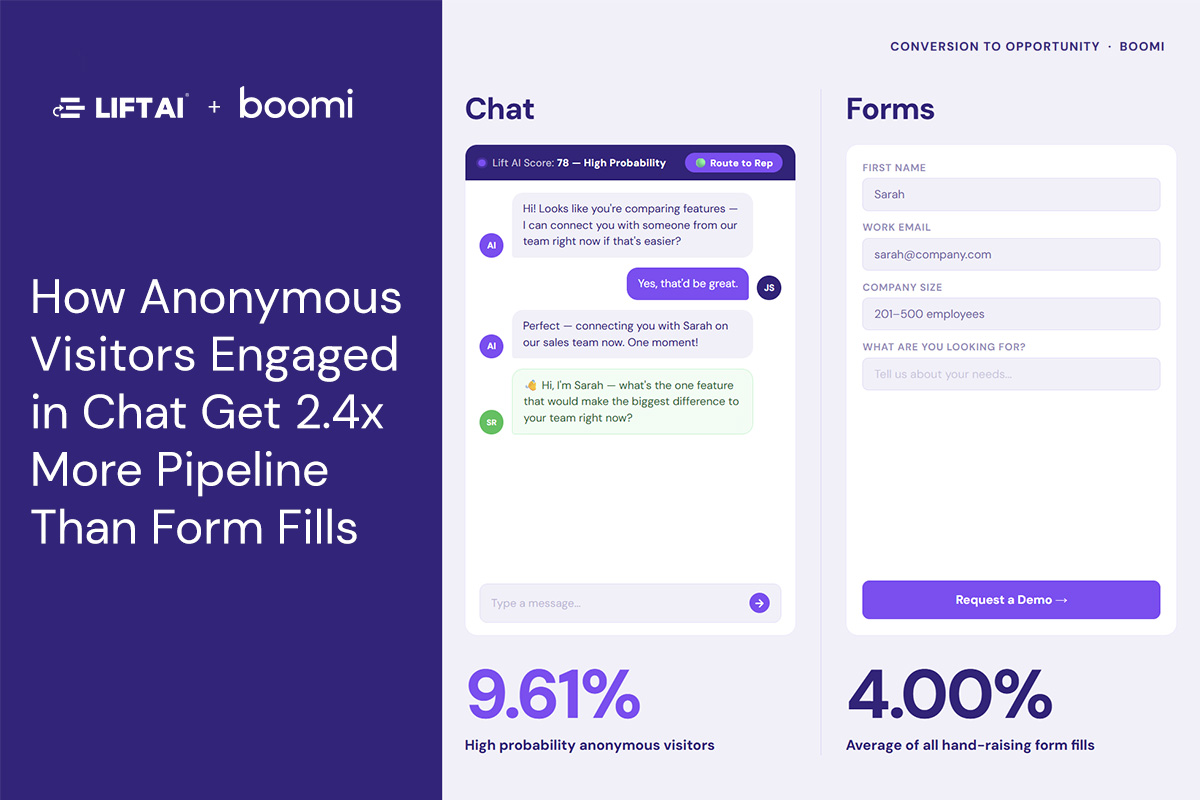
For example, Boomi’s completely anonymous website visitors with a high Website Buyer Probability score are converting to opportunities at 9.61% vs all form fills at 4.00%. That’s a 2.4x difference from people with no ID, no email, and no form fills.
The data is in. And it reframes where buying actually happens, and what that means for your GTM stack.
First: Not All Form Fills Are Equal. And That Alone Should Change How You Operate
A form fill does not tell you the probability that the customer is sales ready. It is a signal that someone was willing to fill out a form. Those are different things.
When you apply Lift AI's Website Buyer Probability Scores to form fill data, the gap between who is genuinely ready to buy and who simply completed a form becomes impossible to ignore:
- Boomi: A high probability form fill is worth 3.2x more opportunities than a low probability form fill
- RealVNC: A high probability form fill is worth 4.4x more revenue than a low probability form fill
- Loopio: A high probability form fill is worth 4.68x more revenue than a low probability form fill
Most teams treat all form fills the same. Same routing. Same sequences. Same enrichment workflows. Same personalization tactics. But it’s clear that approach is actively burning sales cycles and AI tokens on low-probability leads while under-serving the ones most likely to close.
The fix is not complex in practical terms: route high and mid probability form fills directly to reps immediately who have the highest chance of converting them into revenue. Use agents and automation to nurture low. The score does the routing, prioritization, and messaging framework. Your team focuses where it matters.
That finding alone can transform your pipeline overnight. But it is the next finding that should genuinely stop you.
Second: Form Fills Aren’t Your Golden Signal of Buying Intent. Behavior Is
While the form fill data is good, what happens when you apply the same buyer probability scoring to chat is better. Much better.
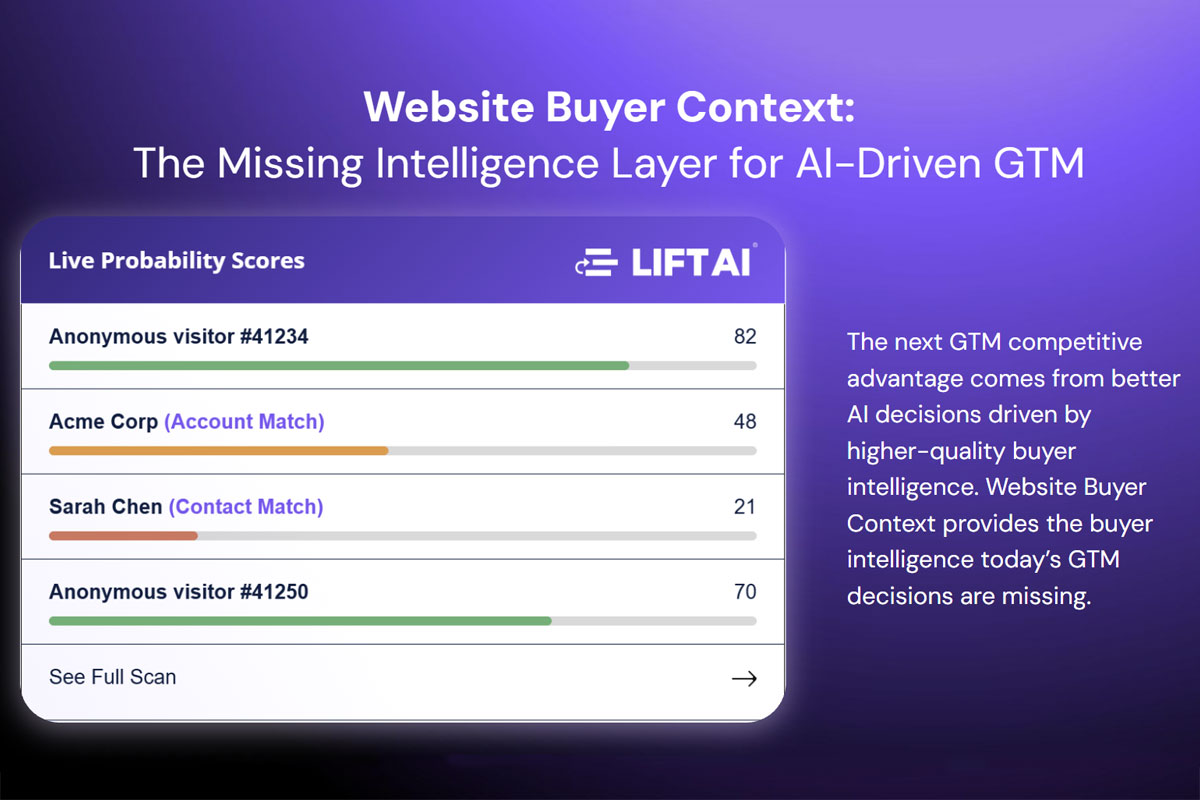
Lift AI scores the buying probability of every visitor — anonymous or known — in real time, using behavioral context trained against billions of website visitors and hundreds of millions of real purchase outcomes, with 85%+ proven accuracy. The score reflects what this visitor is doing. Not what company they work for. Not whether they match an ICP template. And not what the visitor is saying in a form.
That means Lift AI finds buyers before they raise their hand, before they fill anything out like a form.
And that means you can activate Chat engagements timed to the moment their intent is highest, before they leave the website, even if they’re anonymous.
Here is what that produces for Boomi:
An anonymous high probability visitor who never filled out a form — who never asked for sales help — converted at 2.4x the rate of a visitor who explicitly filled out a form.
Compared to low probability form fills specifically, that same anonymous chat visitor was 5.6x more likely to become an opportunity (pipeline).
RealVNC tells the same story from a different angle.
- Overall chat closed rate was 5.70%.
- Overall form fill closed rate was 0.75%.
- That is a 7.6x difference in closed rate from chat vs form fills. This is closed revenue.
There are three key lessons to be learned here:
- That behavior never lies. What someone says (form fill) doesn’t necessarily align to what they do (buying behavior). That’s why there’s a 3.2x difference between High Probability form fills and Low probability form fills for Boomi.
- That engaging visitors in real-time, while they’re on your website, with the right experience in Chat can outperform the “golden” form fill. That’s why Boomi have a 1.35x more conversions to opportunity from Chat vs Forms, and up to 5.75x more conversions when an anonymous high probability visitor is engaged in chat vs a low probability form fill.
- Not all chat engagements should be treated the same - they should be treated differently based on their probability level. That’s why there’s a 6.2x difference between Boomi’s high probability visitors engaged in chat vs low probability visitors engaged in chat.
Why This Happens: The Anonymous Chat Opportunity Is Being Overlooked
The reason chat outperforms forms so dramatically is not that chat is a better format. It is that chat — when powered by Lift AI — is reaching the right people at the right moment, including the ones that your current stack cannot see
On average, 70% of website visitors are completely anonymous. No name. No company. No CRM record. No cookie match. And right now, every AI agent, every enrichment tool, and every intent platform in your stack is treating them as if they do not exist.
They are not low-value visitors. Across Lift AI customers:
- 41% of website pipeline came from anonymous visitors — Okta
- 58% of website pipeline came from anonymous visitors — Boomi
- 54% of website pipeline came from anonymous visitors — Payscale
- 56% of website pipeline came from anonymous visitors — Intelex
The anonymous segment is the largest segment of traffic. It consistently contains some of the highest-intent buyers in your funnel. And it is almost entirely unserved by the modern GTM stack.
Account reveal and ICP matching are valuable for personalization. But they solve for ~30% of your traffic on average. The other 70% who are anonymous are on your site right now and will leave without a meaningful interception.
That is what makes the chat numbers possible. The probability layer finds the buyers in the anonymous traffic. Chat is one of the leading mechanisms for reaching them.
The Elephant in the Room: Chat AI Agents Alone Are Not the Answer
Here is where a lot of GTM teams are about to make a costly mistake.
The natural response to "chat is underutilised" is to deploy an AI agent and point it at the problem. Set it up, configure some rules, let it run on every visitor. Solved.
It is not that simple.
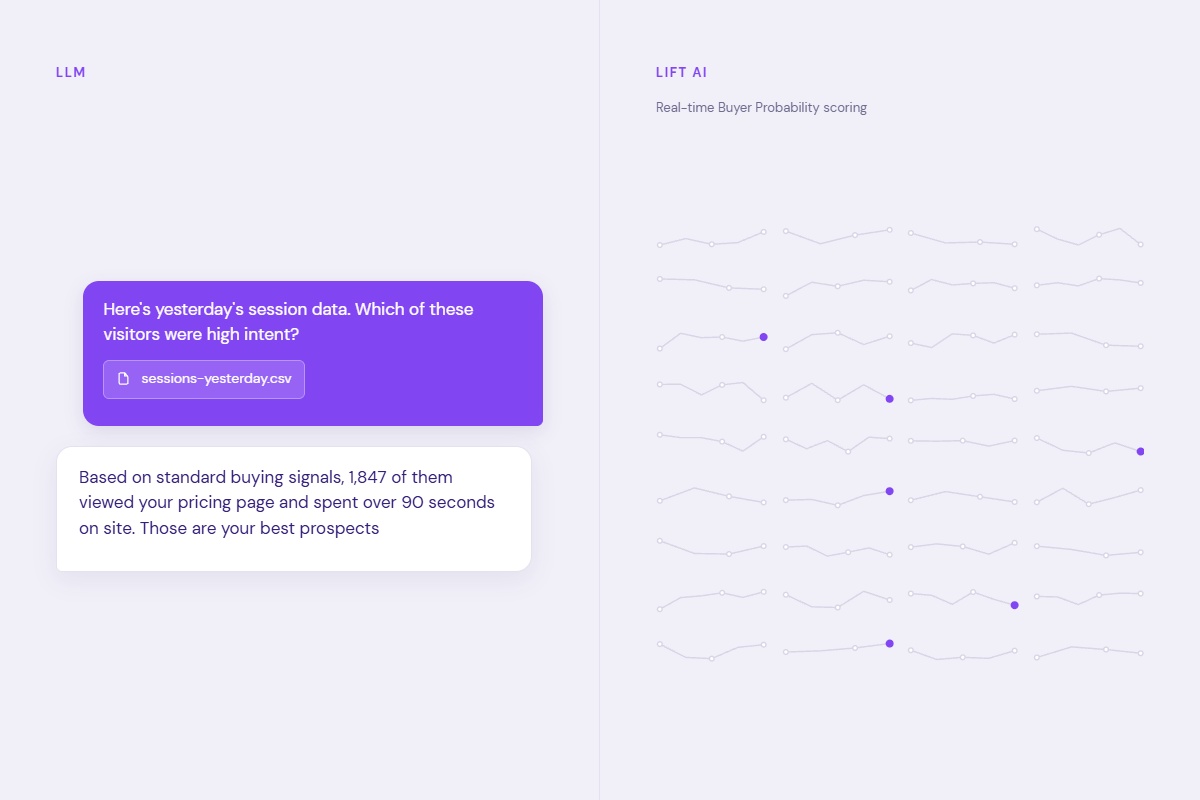
AI agents are genuinely capable — they can hold nuanced conversations, qualify leads, book meetings, and scale across traffic volumes no human team could match. But without an accurate buyer probability score underneath them, they are capable tools operating with the wrong inputs.
Without Lift AI, an agent falls back on rules that sound reasonable but are demonstrably inaccurate:
- "Visited pricing page → high intent." Up to 94% of pricing page visitors are not high-intent buyers. 88% of high-intent buyers never visit the pricing page at all.
- "3+ page views → initiate conversation." Simple rules like page counts or clicks do not correlate reliably to buying behavior.
- Anonymous visitor → generic message. 70% of your traffic gets identical and generic treatment regardless of actual buying stage.
The result is a capable agent confidently doing the wrong thing, at machine speed, across your entire traffic volume.
But when Lift AI scores flow into a chat agent, the operating model changes completely.
- Before any conversation starts, the agent knows whether to engage and how — not based on which page the visitor is on, but on their actual behavioral probability score.
- During the conversation, high probability visitors get direct, friction-free exchanges focused on removing barriers. Mid probability visitors get active qualification. Low probability visitors get genuine value propositions and education without a hard push.
- After the conversation, routing is deterministic: high probability leads go straight to reps, mid enters smart follow-up, low goes into long-term nurture.
But agents are still not the full answer — and this is critical.
Human reps outperform agents with high probability buyers. Not because agents are incapable, but because the highest-probability buyers are evaluating whether they trust your company enough to do a deal. That is a human judgment. It benefits from a human relationship. A rep who can read nuance, respond to unstated concerns, and build conviction in real time will outperform an agent in that specific context. Sometimes it’s as simple as knowing that there are real people with stakes in the game behind a transaction.
The right model is not agents or reps. It is agents and reps — with probability determining who gets which and when. High probability visitors go to reps immediately. Agents handle mid and low. The score is the router.
That’s why Boomi is able to achieve a 9.61% conversion rate from conversation to pipeline for high probability anonymous visitors vs 1.54% for a low probability form fill (a 6.2x difference).
What This Means for Your Entire GTM
Pull these threads together and the picture is clear.
All Form fills are not equal. Route high and mid probability form fills to reps immediately. Use agents for the rest. The 3–5x multiplier between probability tiers is pipeline you are currently leaving on the table by treating them the same in prioritization and personalization.
Chat is not a “set and forget” commodity channel. Backed by buyer probability scoring, it outperforms form fills on every metric that matters — opportunity rate, closed rate, pipeline per visitor. The anonymous high probability visitor who never raised their hand is more likely to close than the visitor who explicitly asked for sales help.
Anonymous visitors are your biggest revenue opportunity right now. It is available overnight with the right implementation of chat. Lift AI scores every visitor immediately after installing (a 5 minute task), including the 70% your current stack cannot see. The buyers are already there. If you focus your reps there, right now, you unlock a significant opportunity that’s currently being overlooked.
AI agents are not the ceiling. They are the right tool for mid and low probability visitors — scalable, consistent, always on. But for the highest probability visitors, reps close more. The architecture should reflect that.
Buying intent is behavioral, not declarative. What someone declares in a form or in a chat response tells you what they are willing to say. What they do across hundreds of micro-interactions on your website is what actually predicts whether they will buy. Lift AI is the model that reads it.
Chat AI Conversions and Form Prioritization Are Just Two of Six Plays
Everything covered in this article — form fill prioritisation and anonymous chat activation — maps to two of Lift AI's six activation plays. The same buyer probability score that powers both of those unlocks four more:
- Surface buyers in matched accounts and contacts. High probability visitors already in your CRM are browsing silently right now. Lift AI detects them and alerts sales before they leave — RealVNC saw 14.4x more revenue per visitor from these hidden accounts versus low probability form fills.
- Find buyers in net-new accounts and contacts. Filter out low probability anonymous visitors before enrichment so you only spend credits on accounts that are actually ready. RealVNC surfaced 962 high probability accounts from 109,000 revealed, saving costs and giving their sales team a focused list to prioritize.
- Optimize website visitor experiences. Show the right content, pop-ups, and CTAs to the right visitor on any page — score-driven CRO rather than one-size-fits-all. RealVNC saw a 94% increase in pop-up click-through rates by doing this.
- Maximize retargeting ROAS. Segment ad audiences by actual buyer probability. Saturate high intent. Suppress low intent. Shift budget toward the visitors most likely to close — RealVNC cut CPL by 67% and doubled leads on the same budget.
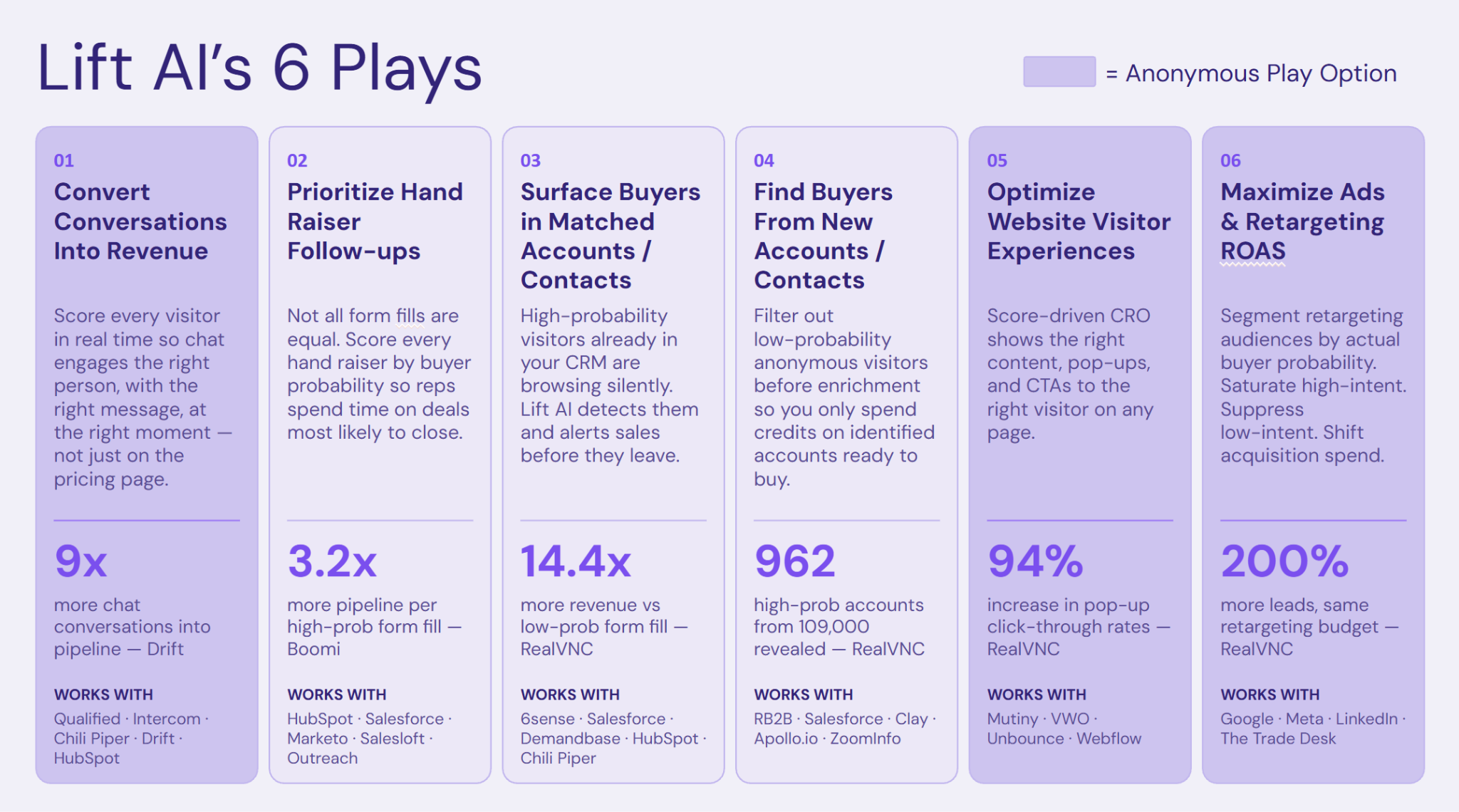
One probability layer. Six places it changes the outcome.
The Practical Starting Point Today
If you are running Conversational AI without buyer probability scoring underneath it, the first step is not to rebuild the stack. It is to add the probability infrastructure that makes everything else sharper.
Lift AI scores flow directly into your reps, tools, and agents. Nothing gets replaced. Everything gets more precise.
The anonymous buyers are already on your website. The question is whether your stack can find them and engage them before they leave - through chat, CRO, retargeting, and much more.
Find the buyers on your website today - Lift AI offers a free 30 day Website Buyer Probability Scan that surfaces your hidden high-probability visitors and shows exactly what your current stack is missing.