
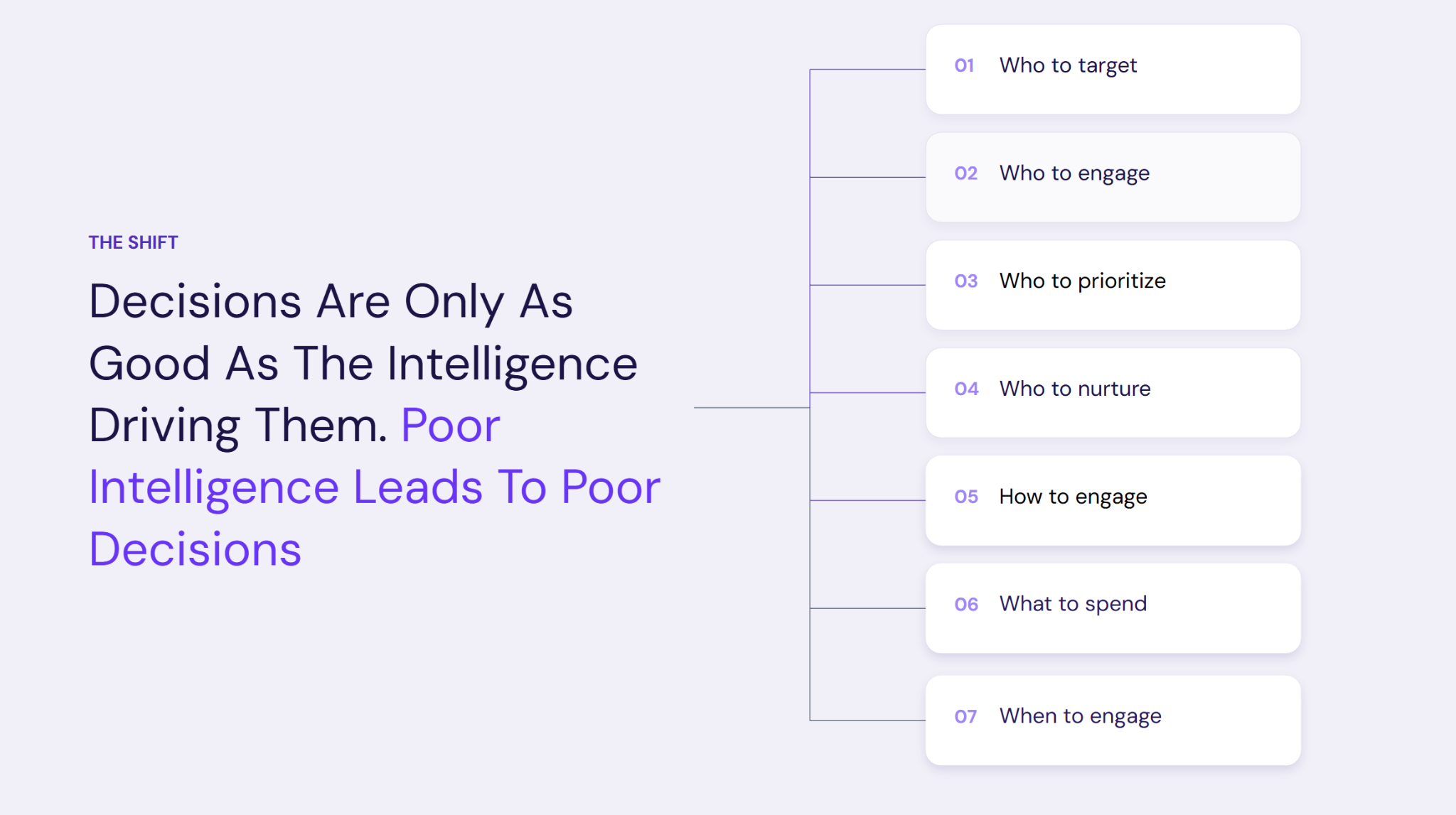
AI’s greatest value in GTM isn’t automating activity – it’s automating decisions. Thousands a day, at machine speed, across every motion: who to target, who to engage, who to prioritize, who to nurture, and how to personalize.
Which raises the only question that matters: Are those decisions any good?
The fact is, AI decisions are only as good as the intelligence driving them. Poor intelligence leads to poor decisions. The problem is that today’s GTM engines rely on static data and isolated intent signals that lack the GTM context needed to identify sales-ready buyers.
Every GTM Decision Boils Down to Three Questions
When we strip away the complexity, GTM workflows are driven by just three questions:
- Who should we prioritize? and
- How should we engage them? and
- Did it work?
Every SDR workflow. Every AI agent. Every conversation. Every chatbot. Every nurture sequence. Every marketing program. Every retargeting campaign. Everything.
No matter how GTM evolves, every system must continuously decide who deserves the most attention and exactly how every prospect should be treated, then understand if those decisions actually worked.
Different workflows. Different channels. Different technologies. But at the heart of every AI-driven GTM system, these three questions drive every automated decision.
Behind The Decisions: What GTM Context Actually Is
The intelligence driving these decisions is primarily GTM context – all the information available about a prospect that helps determine who they are, where they are in their buyer journey and the likelihood they will become a buyer. The more buyer behavior we can observe, evaluate, and correlate to outcomes – the higher quality that GTM context becomes.
This is why context has become the defining GTM trend. GTM context has always determined who wins and who wastes. AI didn’t make it valuable — AI has made the cost of NOT having it far higher.
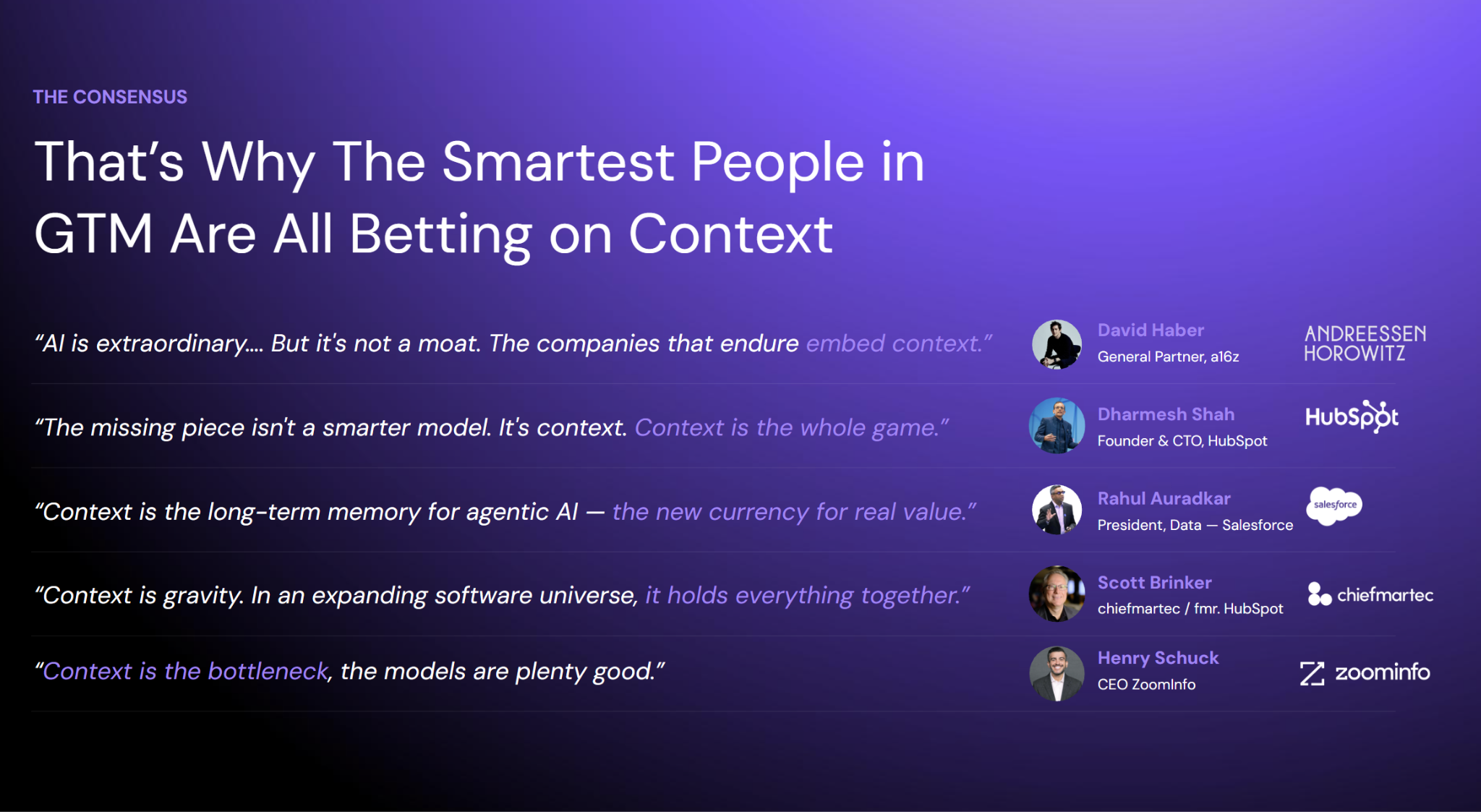
Machines are making thousands of decisions every day - and every one of them runs on GTM context. The quality of each automated decision is only as good as the context behind it.
Because when AI makes decisions without high-quality GTM context, resources are wasted. Reps chase ghosts. Messages miss the mark. Marketing targets the wrong audiences. Teams work harder but generate less return, while leadership commits to forecasts that keep slipping.
The Four Domains of GTM Context Quality
Every layer of GTM technology today is claiming the same word: context.
Yet most versions of “context” describe who prospects are, what they’re doing and what has already happened between you, rather than predicting if they’re going to buy. That means most of today’s GTM context doesn’t accurately answer the three key questions: who to prioritize, how to treat them, or if it turned into pipeline and revenue.
If your GTM context doesn’t know which prospects are most likely to buy, AI can’t prioritize sales-ready buyers and treatment becomes guesswork.
There are four primary domains of GTM context quality:
- 1: Identity Context — describes who prospects are: firmographics, demographics, industry, company size, job titles, technology stack.
- 2: Signal Context — observes what prospects did based on isolated activities: pricing page views, form fills, email opens, third-party intent data.
- 3: Relationship Context — records what has already happened between the prospect and your organization: CRM history, opportunities, sales conversations, previous engagement and existing customer relationships. It’s essential for continuity, but it’s history, not prediction.
- 4: Website Buyer Context — predicts who’s going to buy; which answers who to prioritize with a Buyer Probability Score and how to treat them with a Buyer Context Brief explaining the behavioral context behind the prediction.
The first three levels tell AI who a prospect is, what they’ve done and where the relationship stands. Only the fourth tells it how likely they are to buy right now.
The Richest Buyer Context Lives on Your Website
Every day prospects visit your website to research, compare, and evaluate your solution. As they do, they generate a continuous behavioral story unavailable anywhere else.
Which means your most valuable untapped GTM context is the buying behavior of visitors already on your website. Every other source of GTM context provides only fragments of context for AI to make its decisions.
Every visit creates hundreds of micro-behaviors; including clicks, scrolls, navigation paths, timing, engagement patterns, and countless other interactions that reveal how buyers progress toward a purchase.
Unlike isolated signals collected from different systems at different times, every behavior on your website is observed in the same environment, measured the same way, and captured at the moment buying decisions are being formed.
That consistency makes Website Buyer Context far more predictive than disconnected data points viewed in isolation. That's why your website is the richest, closest-to-revenue source of Buyer Context available to your GTM team.
In fact, it's a GTM goldmine—if you can access it.
Unlocking The Anonymous Majority of Website Visitors
The biggest limitation GTM teams face today is they can only act on the small fraction of prospects they can identify or deanonymize—and the problem is the vast majority of website visitors are completely anonymous.
As a result, the majority of qualified in-market buyers remain hidden within existing website traffic, forcing companies to spend enormous resources competing over the small fraction of prospects who can be identified or raise their hands, while the anonymous majority remain invisible to GTM teams.
But anonymous doesn't mean unqualified, uninterested or unlikely to buy.
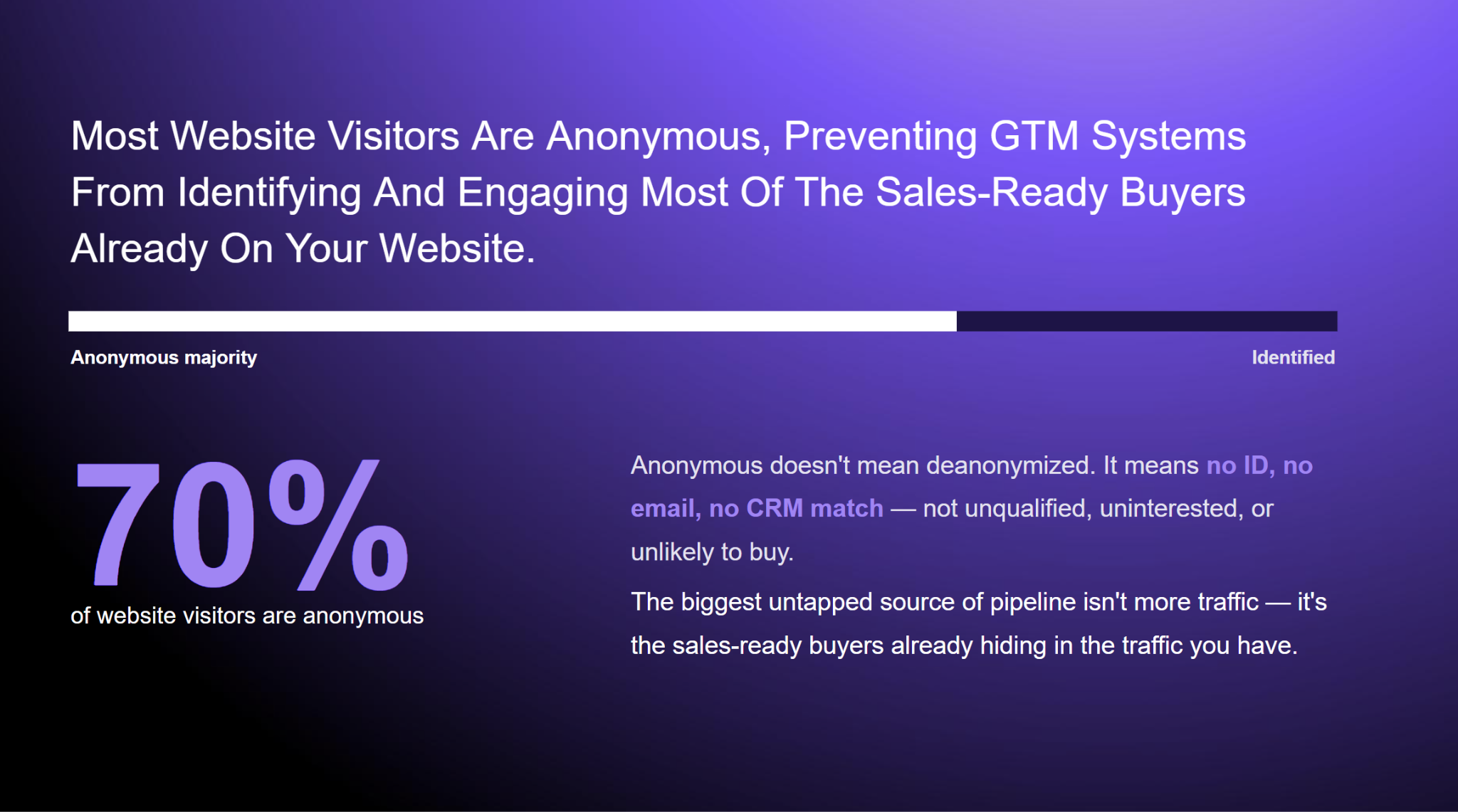
For most companies, the best opportunity to generate more pipeline and revenue is to surface the anonymous buyers hidden within their existing website traffic – before they raise their hand or move to a competitor's offering.
Passing The Hardest Test in GTM Intelligence
Anonymous visitors are the hardest problem in GTM intelligence because traditional GTM context layers depend on identity.
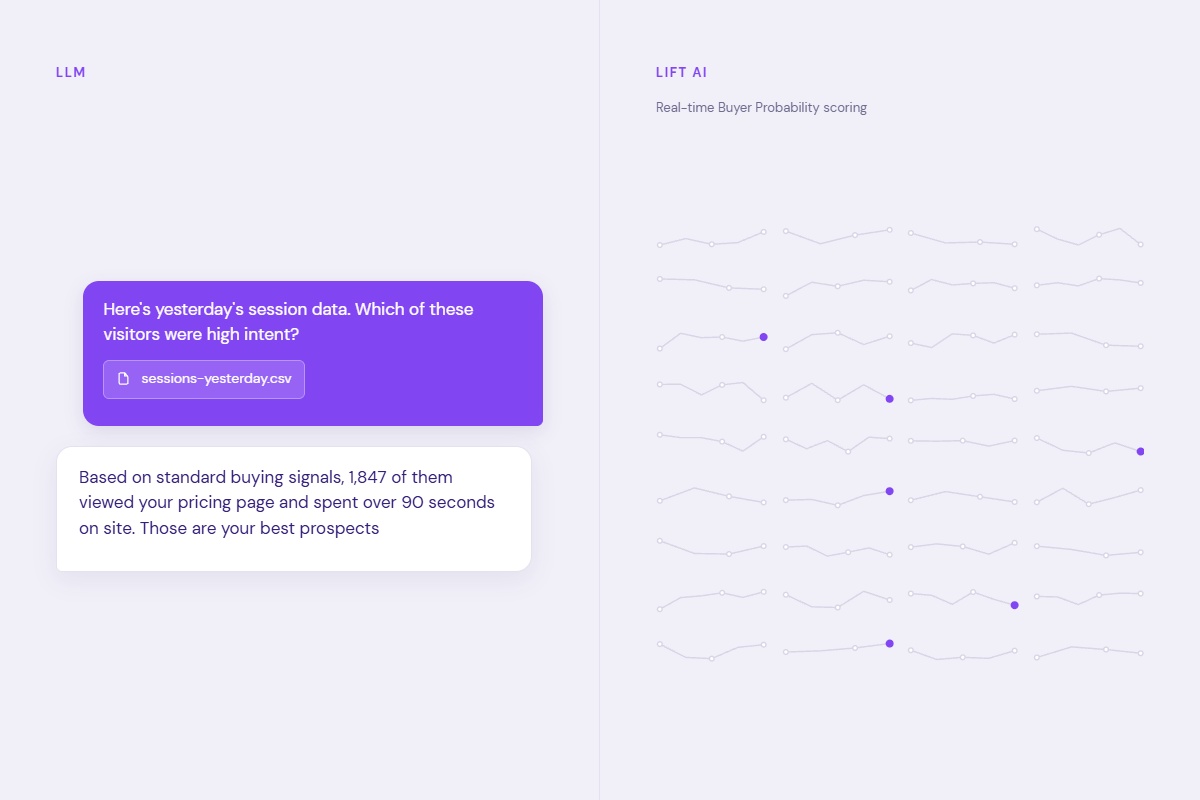
But if you look at a prospect based entirely on their behavior, not their identity, things change. Behavior doesn't require visitor identification to predict buying probability. No CRM record. No identity. No enrichment. No email. No company. No conversation history.
Every context layer in the GTM stack — identity resolution, account-based platforms, conversation intelligence, contact databases — reaches its structural limit here. No identity to resolve, no contact to enrich, no conversation to analyze, no account to match.
That’s why it’s the hardest test. If a model can predict the buying probability of anonymous website visitors – where identity-based context layers can’t reach — that prediction becomes even more valuable when identity, account, CRM, and conversation data are available.
The Missing Intelligence Layer: Website Buyer Context
The missing piece isn’t more data or more signals – it’s how to transform Buyer Context generated by every website visitor into intelligence your GTM engine can actually use.
The challenge is that every visitor generates hundreds of micro-behavioral interactions that reveal buying patterns over time. Understanding what all of that Buyer Context actually means – and accurately determining which visitors are sales-ready – is beyond human capability.
It takes purpose-built machine learning, trained on revenue outcomes, to solve that problem.
Built from billions of website visits and millions of commission-audited sales outcomes, Lift AI is a pre-trained intelligence layer that continuously reads, evaluates, and correlates the buyer behavior of every website visitor to revenue – both known and anonymous.
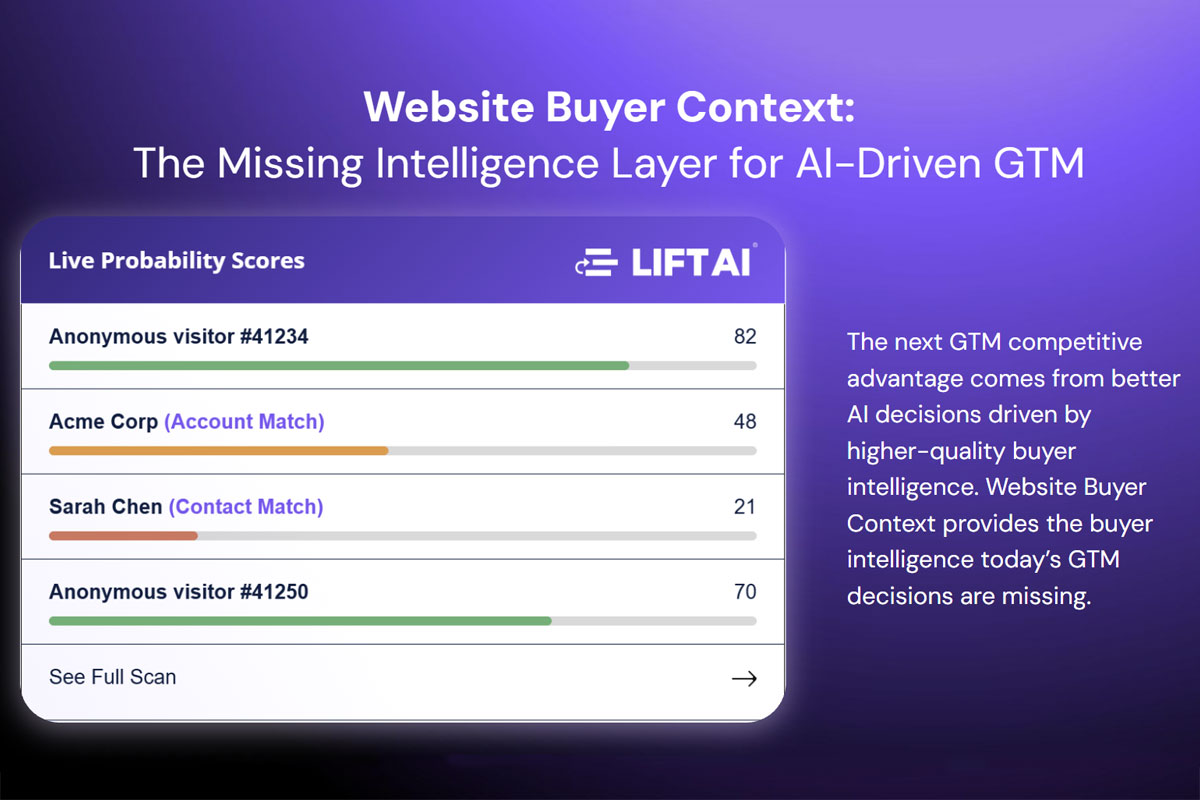
It then resolves that Buyer Context into a single Website Buyer Probability Score™ (0–100), which predicts, with 85%+ proven accuracy, how likely each visitor is to become a buyer. Each score also includes a Buyer Context Brief with the behavioral context behind the prediction – including the Buyer Profile the visitor matches, the Areas of Focus that matter to them, the Behavioral Trace behind the score and the Recommended Action to take.
Together, these answer two of the three critical GTM questions: who to prioritize and how to treat them.
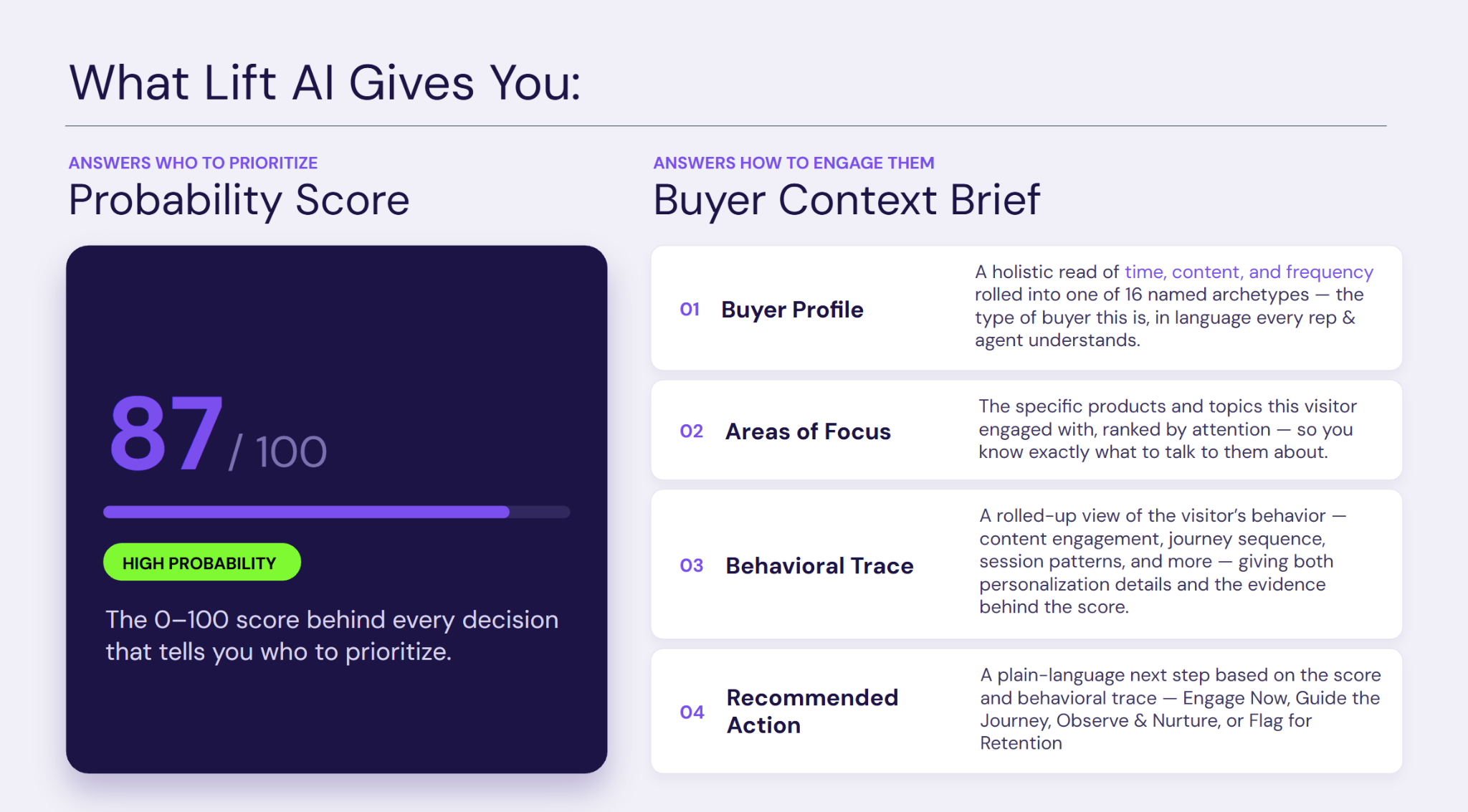
Two questions. One intelligence layer.
Website Buyer Probability Scores transform Buyer Context into an actionable prediction every GTM system can use. For anonymous website visitors, they enable prioritization and treatment decisions that were previously impossible. For known visitors, they improve those same decisions already being made across your GTM ecosystem.
Activating Website Buyer Context Using Six Proven GTM Playbooks
Buyer Probability Scores and Buyer Context Briefs power proven plays across three areas of your GTM ecosystem — Website Conversions, Sales Prioritization, and Ad Optimization, enabling smarter decisions on who to prioritize and how to treat each prospect - driving greater pipeline and revenue growth.
Every website visitor is segmented into Low, Mid, and High Probability buyer groups based on their Website Buyer Probability Score™, enabling every GTM system to prioritize prospects and personalize treatment based on each visitor's buying probability.
Here’s how the plays work in each area:
Website Conversions:
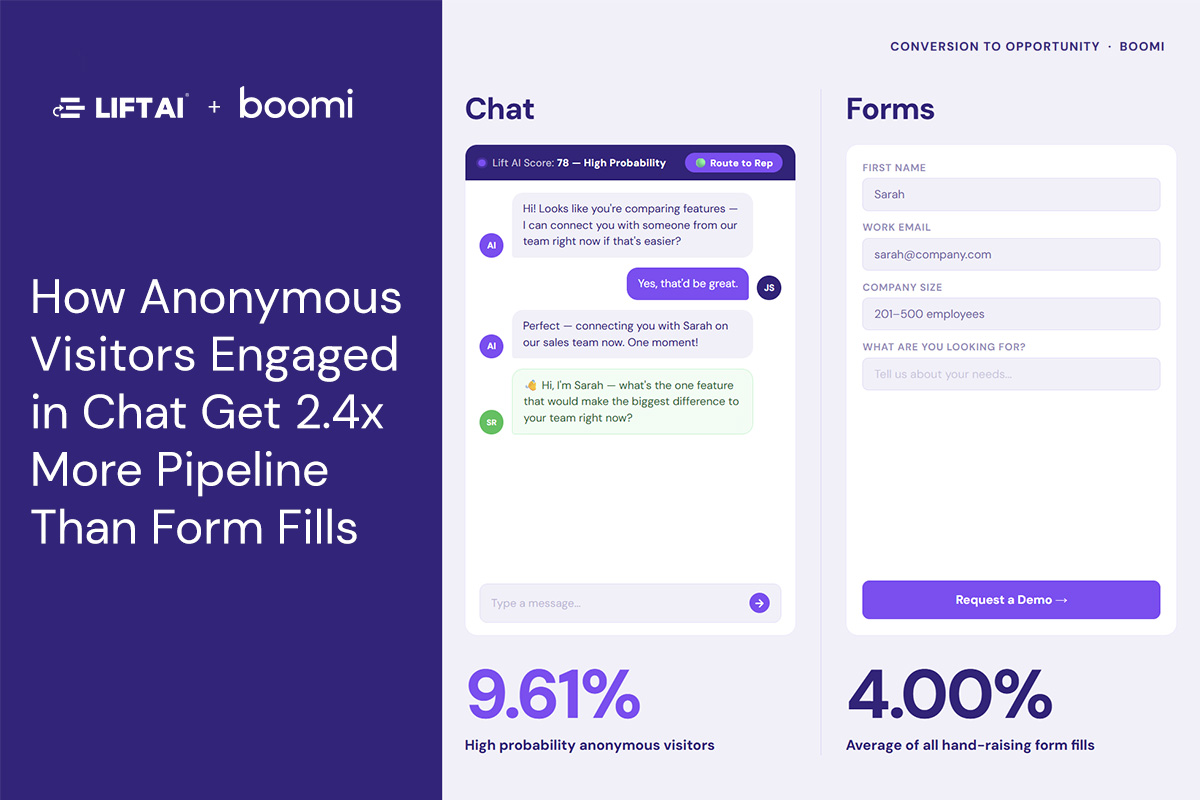
- Chat, Conversational AI & Forms (Qualified, Chili Piper, Intercom): Route High-probability website visitors straight to reps, Mid to AI, Low to nurture, the moment they engage. Works with both Anonymous & Identified visitors.
- Website Experience & CRO (Mutiny, Optimizely, VWO): Personalize by probability — sell to High, nurture the rest. Works with both Anonymous & Identified visitors.
Sales Prioritization
- Follow-Up Prioritization (Salesforce, HubSpot, Salesloft): P1 follow-up goes to the visitors the Score says are actually likely to buy, not just the ones who filled out a form. Works with Identified visitors via Form Fills, Chat, Pop-ups, etc.
- Matched Account Prioritization (6sense, Demandbase, Clay): Surface the CRM accounts browsing your site silently, before they ever raise a hand. Works with Identified accounts matched to your CRM or ABM lists.
- Net-New Account Discovery (RB2B, Apollo, ZoomInfo): Rank newly revealed accounts by buying probability the moment they're identified. Works with Identified visitors revealed through Identity Resolution.
Ad Spend
- Retargeting & Ads (Google, Meta, The Trade Desk): Fund the high-probability buyers, even the ones you can't yet identify. Works with both Anonymous & Identified visitors.
Three of these plays — chat, CRO and retargeting — can act on anonymous visitors that identity-based tools largely can’t reach. The other three make the tools already prioritizing known accounts and contacts smarter, by replacing a guess with a probability.
Why 85%+ Accuracy Changes Everything
Predicting which website visitors are most likely to become buyers is only valuable if those predictions are consistently accurate. Across real-world enterprise deployments, Lift AI has consistently demonstrated 85%+ proven predictive accuracy, measured by grading each customer’s own traffic against real outcomes as lift over the base rate, for its Website Buyer Probability Scores.
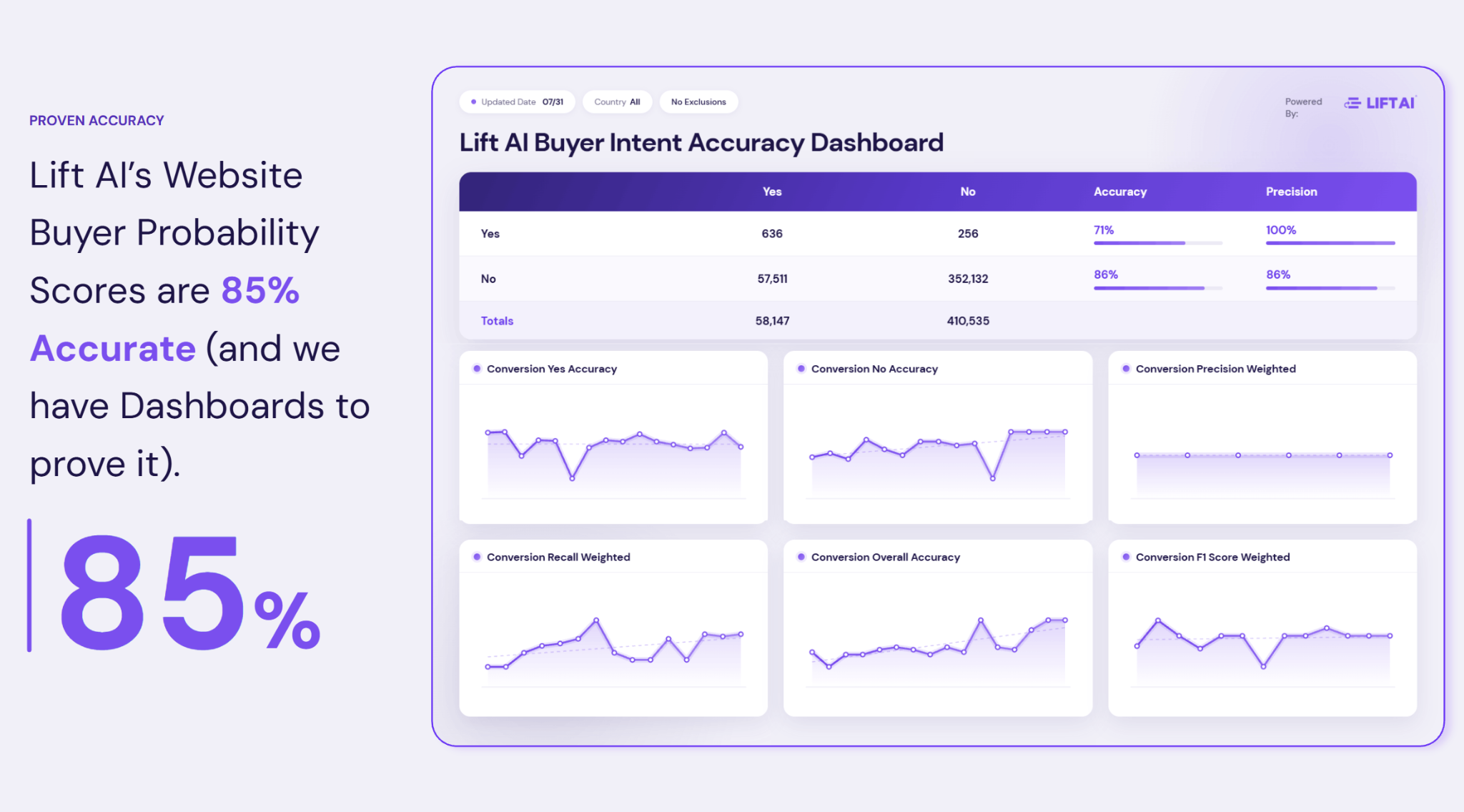
When your GTM engine makes prioritization and treatment decisions based on a prediction that is 85%+ accurate, the decisions that depend on it get measurably better.
Speed: Intelligence Is Only Valuable While the Buyer Is Still Buying
Accuracy determines whether a prediction is right.
Speed determines whether it still matters.
Most GTM signals are latent — captured, queued, enriched, and surfaced hours or days later, long after the buyer has left the website and often after they've already engaged a competitor. When buyers so often choose the vendor that responds first, delayed context doesn’t just lose value — it loses revenue.
Lift AI scores and activates in real time. As visitors interact with your website, the model reads their behavior and resolves it into a Website Buyer Probability Score while the buyer is still on the website, continuously updating in real time as new behavior occurs.
Activation can occur in the same session or within minutes of the visitor leaving the website, so every GTM decision reflects what's true right now, not what was true yesterday.
Improving Your Entire GTM Ecosystem
Lift AI is the intelligence layer that makes your entire GTM stack more effective. Every system, sales rep, AI agent, and marketer that makes a who-to-prioritize or how-to-treat decision gains a new input it's currently missing: Website Buyer Context.
It installs in minutes with nothing to rip out or replace, and every deployment includes a Revenue Loop to measure your brand's predictive accuracy and revenue outcomes.
Lift AI isn’t built to replace anything in your stack — it makes what’s already there smarter.
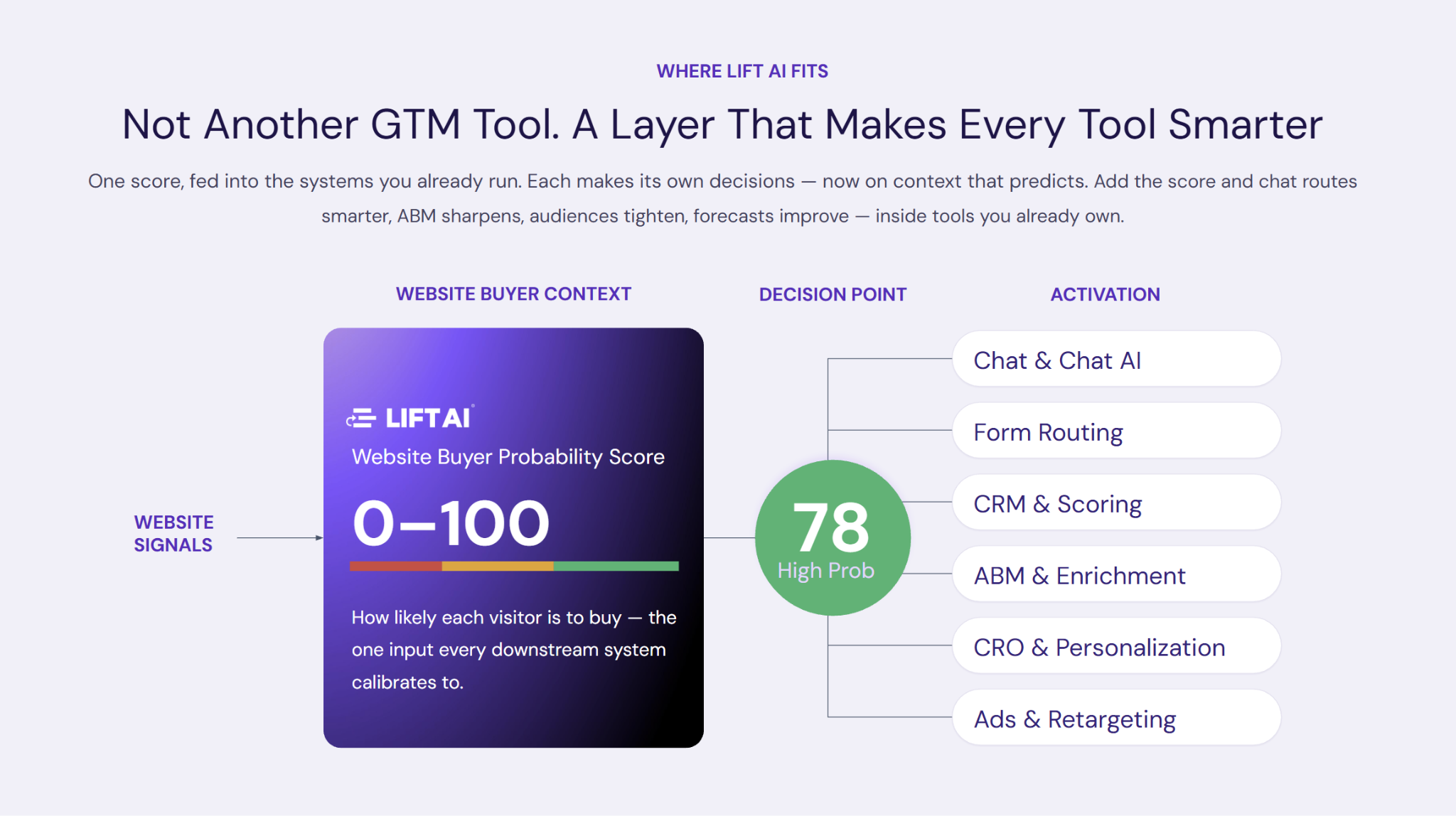
Keep the stack. Add the score it's missing.
The Revenue Loop: Predictive Accuracy and Revenue Per Visitor
This answers the third key question in GTM: did the decision actually work?
The accuracy of context alone isn't enough. The ultimate test of GTM context is whether better decisions generate better business outcomes—not more clicks, more conversions, or more leads in a pipeline that never closes.
Most GTM tools stop at activity: Did the visitor convert? Did they fill out the form? Did the score go up? None of that tells you whether your buyer context actually generated more revenue.
That’s what Lift AI’s Revenue Loop is for. Where outcome data is connected, it reports on the accuracy of the prediction using Outcome Validation, the results from specific plays using Performance Measurement, and where outcomes are available to feedback into systems, an Agentic Learning Loop.
The Results: Better Intelligence Drives Better Outcomes
Lift AI’s Website Buyer Probability ScoreTM has been validated across real-world enterprise deployments, consistently improving prioritization, engagement, pipeline and revenue outcomes.
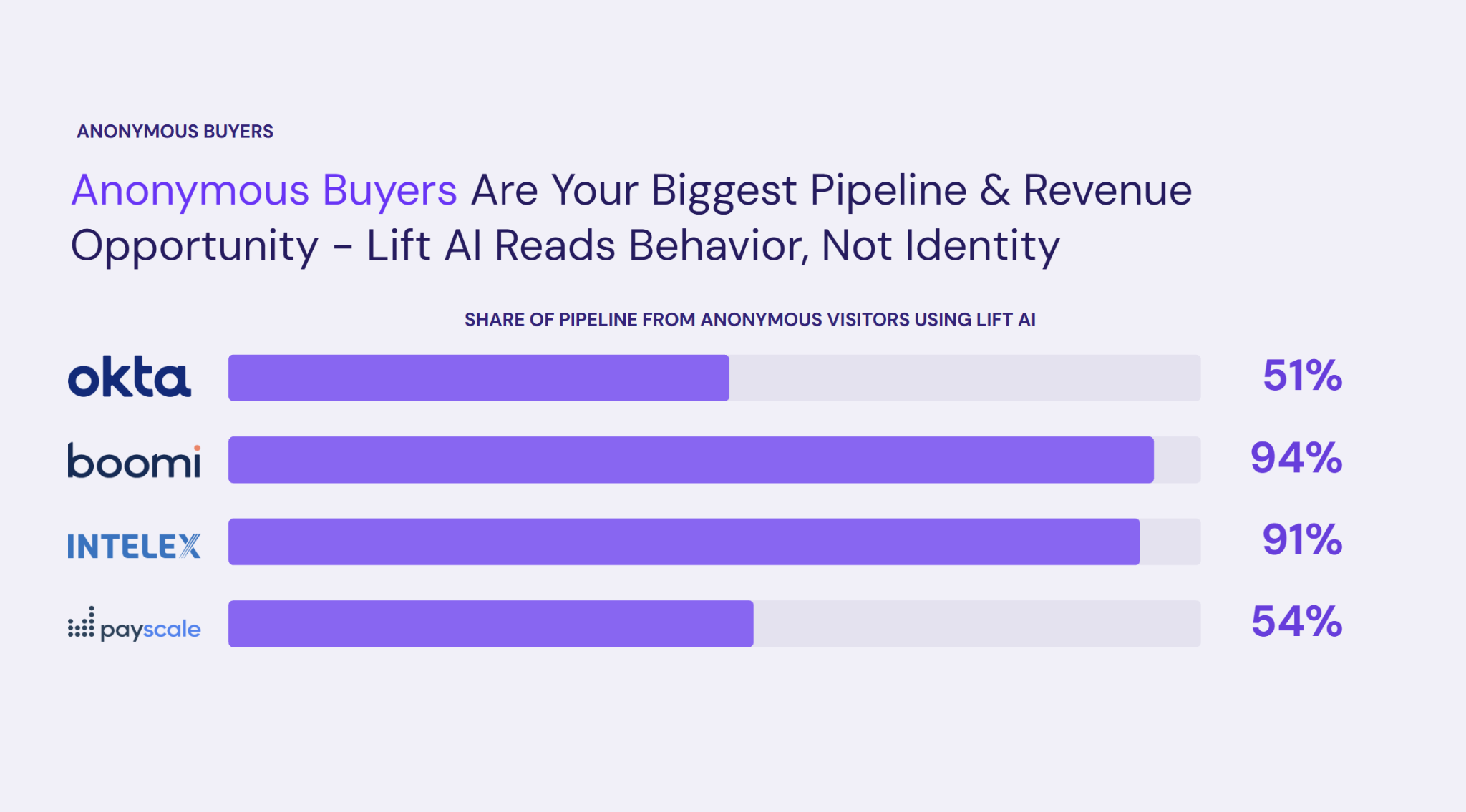
Boomi – Anonymous Traffic: After deploying Lift AI for 18 months, Boomi identified and engaged high-probability buyers across its anonymous website traffic (90.1% of website visitors), which went on to generate 94.4% of all chat-driven revenue.
Boomi – Form Fills: By adding Website Buyer Probability Scores to prospects who submitted forms, Boomi discovered that High Probability form fill prospects converted into opportunities 3.2X more often than Low Probability submissions.
Boomi – Conversations: Replacing page-based engagement rules with Website Buyer Probability Scores resulted in a 23.4X increase in chat-driven closed revenue over 18 months. The same website. The same team. The only structural change was the intelligence driving prioritization and engagement.
RealVNC - Retargeting Ads: Cost per lead dropped 67% while lead volume increased 200% with no increase in ad spend. Website Buyer Probability Scores enabled RealVNC to concentrate retargeting advertising investment on high-probability buyers while reducing spend on low-probability visitors.
Fluke Health - Revenue: Fluke achieved a 345% increase in Revenue Per Visitor when its Intercom engagement was driven by Buyer Probability, measured by tracing closed revenue back to each visitor’s original Website Buyer Probability Score.
The Competitive Advantage
The next GTM competitive advantage comes from better AI decisions driven by higher-quality Buyer Context from the GTM assets you already own. Sales-ready buyers are already on your website. The opportunity isn't to generate more activity – it's to identify, prioritize and engage the hidden buyers actively evaluating a purchase.
Website Buyer Context transforms real-time buyer behavior into Website Buyer Probability Scores™ that improve every AI-driven decision across your GTM ecosystem. Proven plays across three areas activate that context, while predictive accuracy and Revenue Per Visitor validate both the quality of the prediction and the business outcomes it creates.
Website Buyer Context provides the buyer intelligence today's GTM decisions are missing. Start your free 30 day website scan to see how Lift AI can unlock the anonymous visitor opportunity and strengthen your entire GTM system.
About Lift AI
Lift AI is the Website Buyer Context layer for the GTM stack. It continuously interprets the behavior of every website visitor, known and anonymous, and transforms that Buyer Context into a Website Buyer Probability Score™ (0–100) that predicts how likely each visitor is to become a buyer with 85%+ proven accuracy.
Trained on 15 years of commission-audited sales outcomes spanning billions of website journeys and millions of verified purchases, Lift AI enables GTM engines to make better decisions about who to prioritize and how to treat every website visitor.