
Most 'signals' aren't buying signals at all. Here's why the distinction between signals and buying probability could be the most important shift in modern GTM — and what to do about it.
There's a reason signals are everywhere right now.
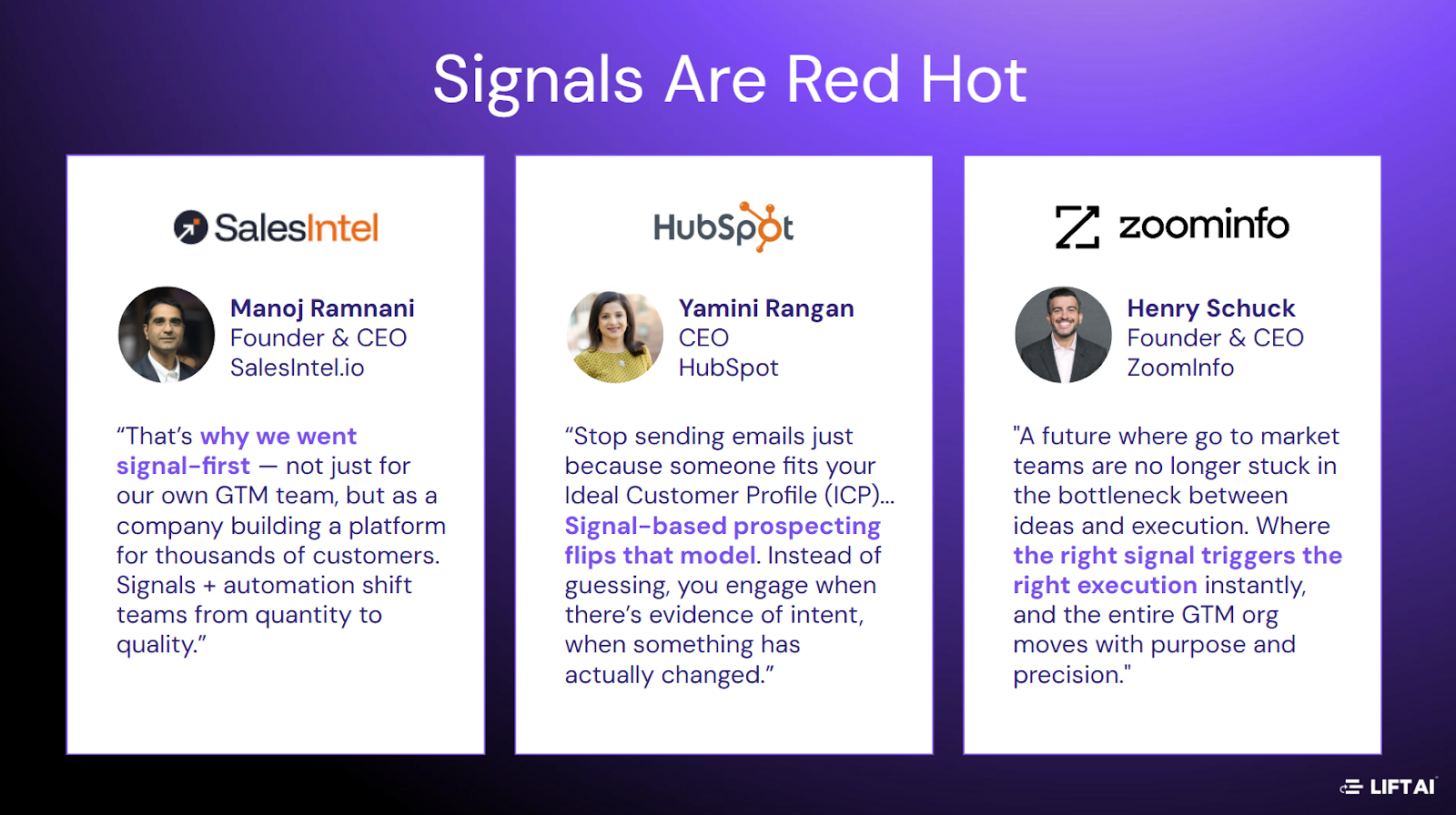
Jon Miller, one of the architects of modern B2B marketing, has called signal-based orchestration the future of martech. The CEOs of ZoomInfo, HubSpot, and SalesIntel are all talking about signals as the next frontier. And they're not wrong — the signal economy is real, it's growing, and will continue to be a fundamental part of GTM infrastructure for years to come.
But there's a problem hiding inside the excitement.
More signals do not mean better decisions. It can mean the opposite.
And it’s the reason why the current AI movement in GTM hasn’t delivered its promise.
Why Billions in AI Investment Is Failing
GTM teams are betting billions on AI and agents to transform revenue performance. Boston Consulting Group reports that only about 5% see meaningful ROI from those AI investments, and for up to 60% there is little to no tangible benefit at all.
This isn't an AI problem. AI does exactly what it's designed to do: it executes at scale, faster than any human team ever could.
The problem is what’s feeding AI. Garbage in equals garbage out. And now it’s happening faster.
“When execution is infinite, the quality of what you're executing on becomes everything. AI doesn't fix bad inputs — it amplifies them”.
The bottleneck is no longer execution speed. It's prioritization.
Today’s GTM prioritization is the outcome of decisions increasingly made by AI, including which prospects to engage, how to communicate, and where to invest GTM resources.
Which means the quality of AI-driven GTM decision-making and the resulting flow of prioritization is only as good as the quality of the data and signals it receives from the start.
The problem is that today’s GTM signals don’t reliably give you an accurate buying probability for individual prospects being fed into your GTM machine.
The Missing GTM Layer: Buyer Probability
It’s clear that the signal economy is missing a critical layer. One that sits above the noise and tells your entire GTM stack — with accuracy — who is most likely to buy right now.
That layer is buyer probability - because the most valuable GTM signal is a statistically significant and accurate representation of who is ready to buy, and who is not right now.
When GTM stacks are driven by accurate buying probabilities, everything downstream improves — including more efficient and effective sales prioritization, personalized messaging, AI agent workflows, and ad spend.
And together this results in a greater volume of sales-ready leads, more pipeline, more revenue, better ROAS, and lower CAC.
But first, you need to understand why buyer probability is the solution and the driving force behind it.
Most 'Signals' Are Not Buying Intent Signals
Let's be precise about something the industry glosses over.
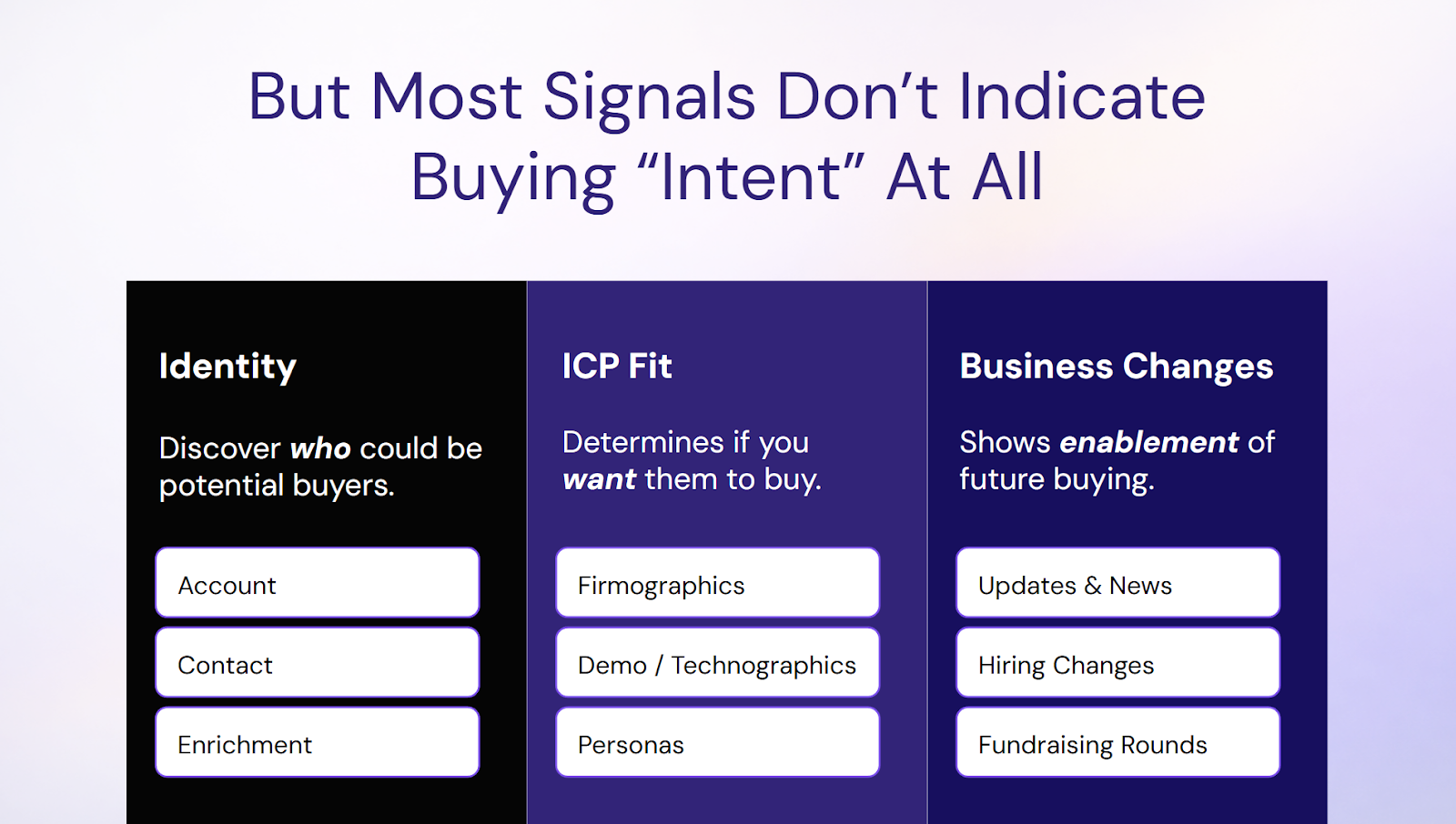
The vast majority of “intent signals” aren’t signals of buying intent at all.
They’re raw data or observations about activity.
- A company hires a new VP.
- Someone downloads a whitepaper.
- A company gets a new round of funding
- A contact matches your ICP.
These observations might eventually correlate with buying behavior, but they do not accurately predict the probability of in-market buyer readiness.
The Accuracy Problem of “Buyer Intent” Signals
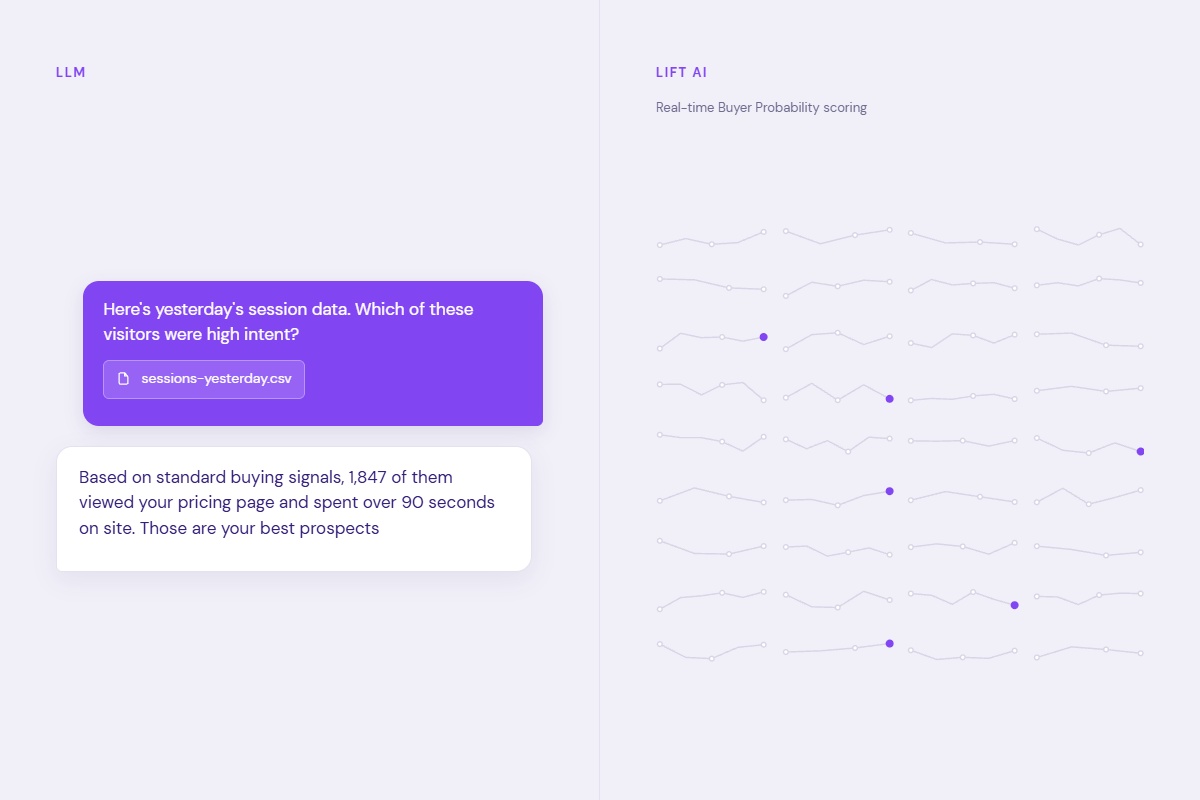
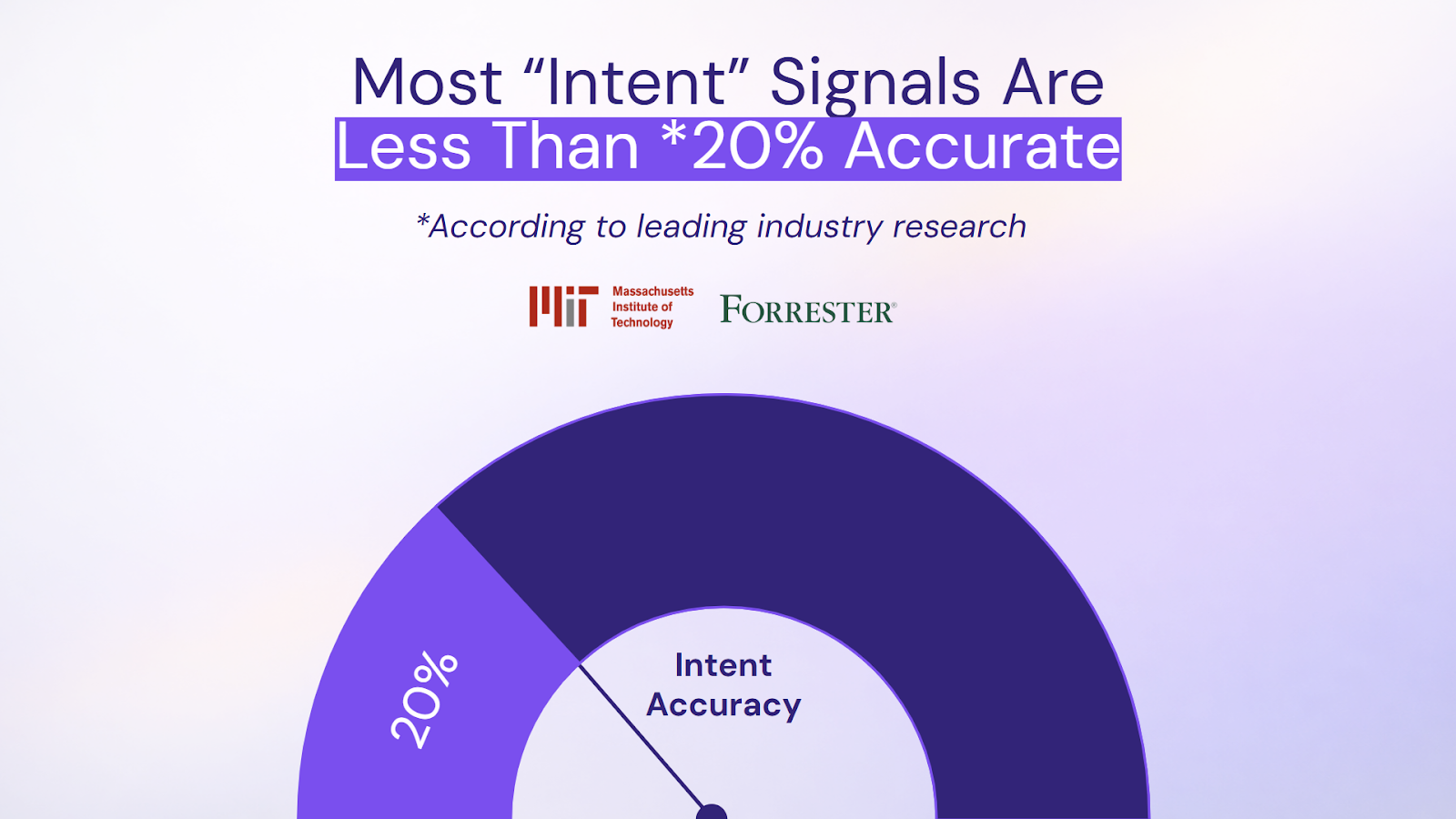
Most “intent signals” used in modern GTM systems are less than 20% accurate when it comes to identifying real buyers.
Even signals widely considered the “holy grail” of buying intent are deeply flawed.
Take the pricing page view.
It’s one of the most commonly used signals in GTM automation and sales prioritization.
But up to 94% of pricing page visits come from people who will never buy.
- Competitors checking pricing.
- Existing customers.
- Low-intent, early-stage curiosity.
- Bots crawling your website
The same problem exists with form fills, which are often treated as the ultimate signal of buyer readiness. Yet we have case studies proving that up to 60% of form submissions come from low-intent prospects who only convert to 8% of revenue.
Another client deprioritizes forms scored as low buying probability by Lift AI, even if a form fill says "Need a Quote", because it most often means that the prospect is gathering quotes to meet procurement criteria and by that point, it’s already too late in the sales cycle.
Meanwhile, traditional lead scoring relies on simplistic, human-defined rules and weightings for prospect activity such as email opens, page views, attending a webinar, and ad clicks. These are typically proxies for buying intent, not an accurate measure of buying probability. And over time, those assumptions compound into misprioritization at scale.
The Opportunity That Signals Miss Entirely: Anonymous Website Visitors
Almost all GTM systems are designed to operate on identified accounts and known contacts.
But the majority of real buying behavior occurs long before a buyer ever identifies themselves.
Depending on your traffic, 70–95% of the visitors on your website remain anonymous — researching your product, evaluating alternatives, and progressing through their buying journey without ever being ID revealed or matched, filling out a form or entering your CRM.
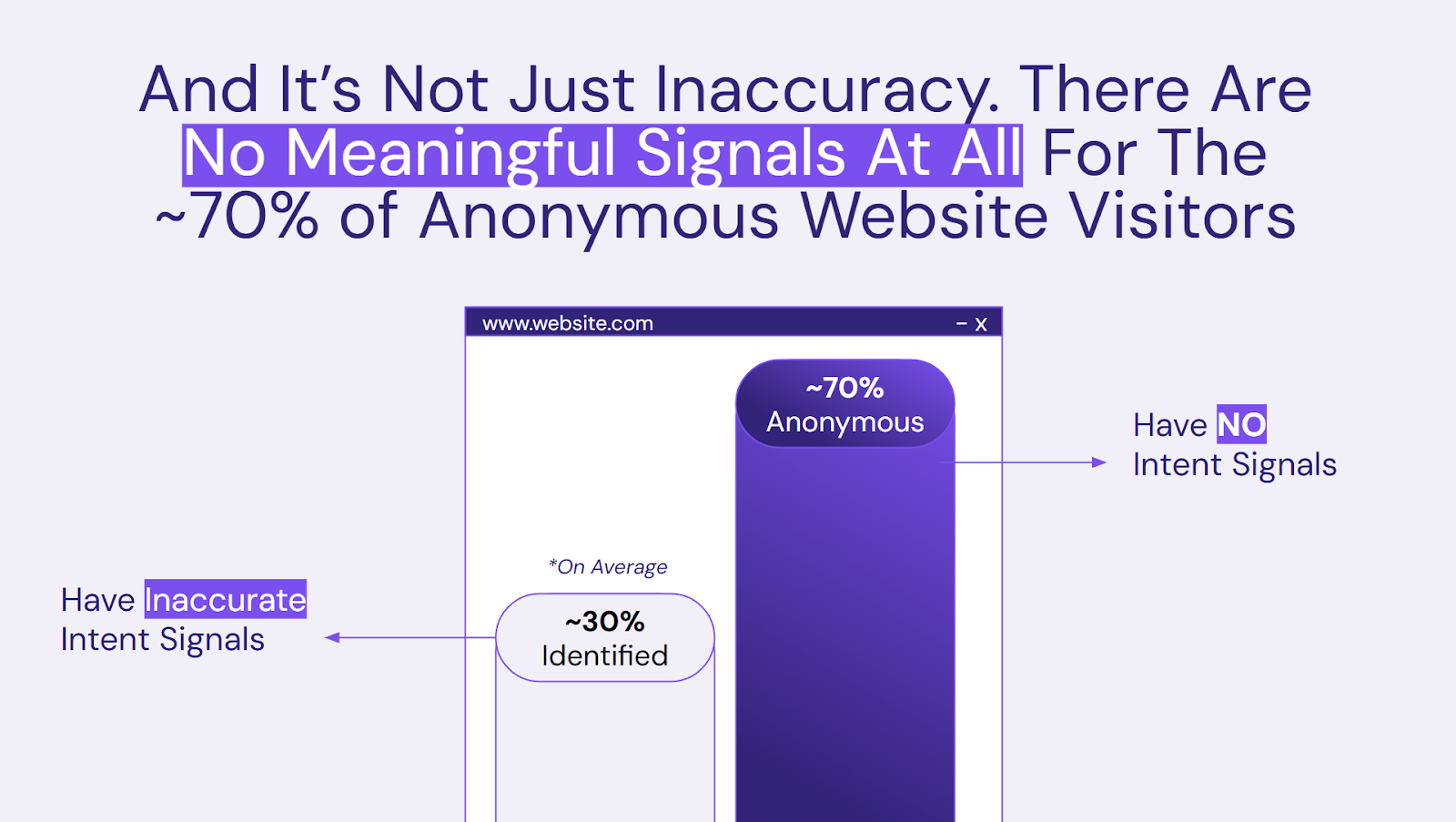
Yet modern GTM systems are almost entirely blind to this activity.
Your GTM stack has no signal whatsoever for the majority of people who are completely anonymous, but are actively researching you on your website.
The result is a massive intelligence gap: the majority of potential buyers interacting with your brand generate no usable signal at all inside your GTM stack.
The result is a GTM system that looks sophisticated on the surface but is fundamentally flawed underneath, leading to missed opportunities and compounding downstream costs.
The Result: Missed Buyers and Scaled Noise
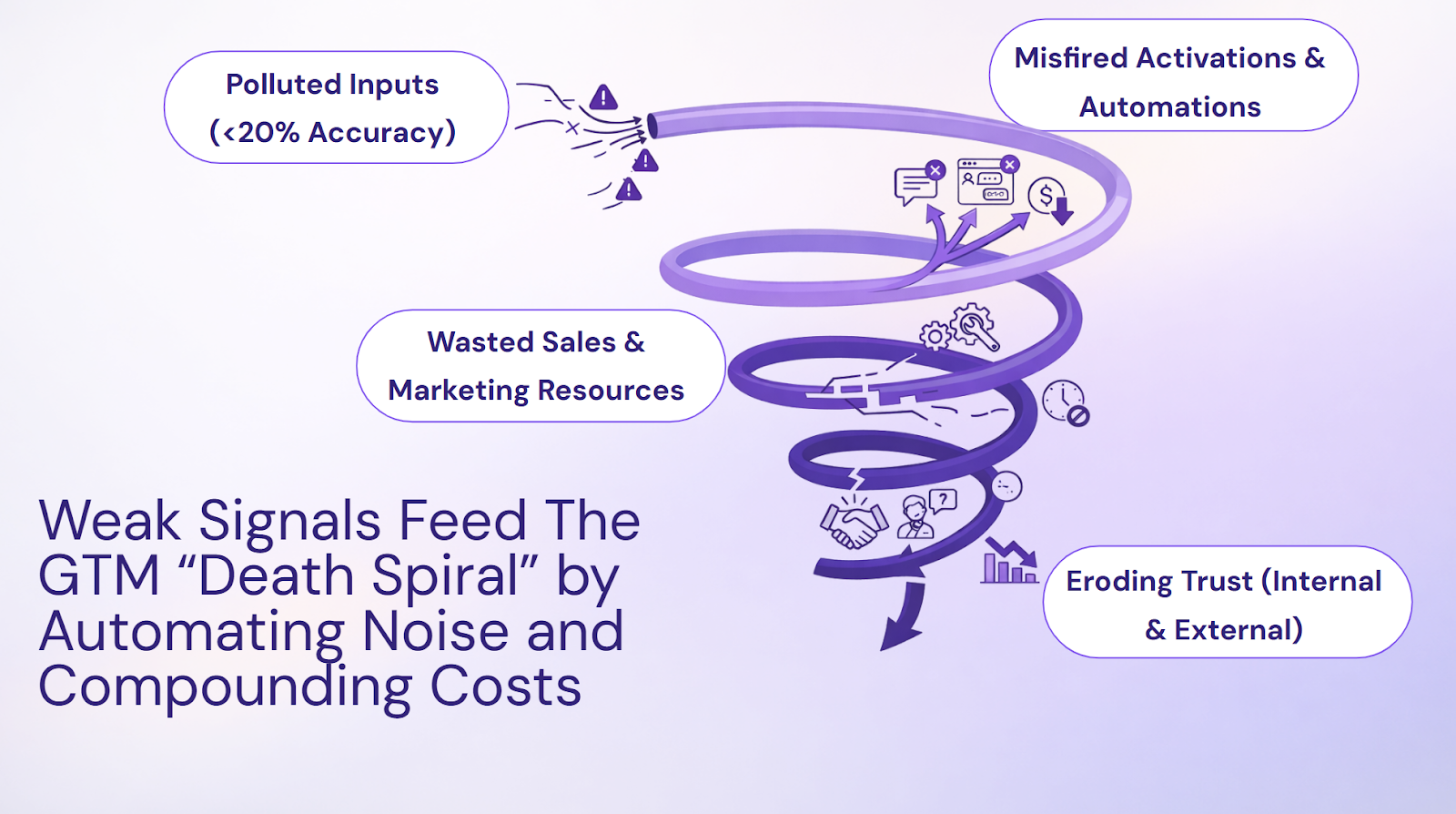
When you put together signals that aren’t buying signals, buying signals that are inaccurate, and anonymous visitors that get missed entirely, you get what should give every GTM leader pause: the “GTM Death Spiral”.
- AI agents and automation fire entire workflows on dead-ends
- Reps prioritize the wrong leads while missing the right ones
- Ad spend is burned on people who will never buy
- Teams become frustrated with tools, each other, and don’t hit targets
- Meanwhile, anonymous website buyers are completely ignored and overlooked
It’s clear that these problems need to be solved at a foundational level.
Your AI-driven GTM engine and its entire orchestration of signals and workflows needs to be grounded from the very start with something more accurate and reliable, ready to scale.
The Solution Starts With Behavior, Because Behavior Never Lies
There's a reason the old saying exists: behaviour never lies.
What people say and what they do are often two very different things.
Form fills are the clearest example. A prospect actively reaching out, requesting a demo, asking for a quote — it looks like the strongest possible buying signal. Yet up to 60% of those submissions come from people whose behavioural patterns before that form tell a completely different story: low intent, early curiosity, support, or procurement box-ticking.
The form told you what they said. Their behaviour told you what they meant.
This is the crux of why existing signals fall short. They don't measure behaviour — they observe isolated activity and treat it as intent.
A pricing page view is a single data point. Like a stranger glancing at a restaurant menu in a window — it tells you they looked, but nothing about whether they're hungry, whether they can afford it, or whether they'll walk in. Without the context of what came before and after that activity, the observation is often meaningless.
In GTM, that context is everything. And the market's leading minds are starting to say so directly.
“Context is the new product. Structuring that intelligence, opening it up and making it the foundation that an entire ecosystem of humans and agents can build on."
Scott Brinker, Chiefmartec
“This is why most AI deployments underwhelm. The missing piece isn't a smarter model. It's context… Context isn't a feature. It's the WHOLE GAME.”
Dharmesh Shah, Founder & CTO @ Hubspot
The most critical capability in modern GTM isn't collecting more signals. It's interpreting the signals that demonstrate real buying behaviour with enough context to be statistically meaningful.
And the asset with the richest concentration of buyer behaviour context is one most enterprise companies already own, already invest in, and almost entirely underutilise:
Your website.
Why Your Website is The Key to Sustainable GTM Growth
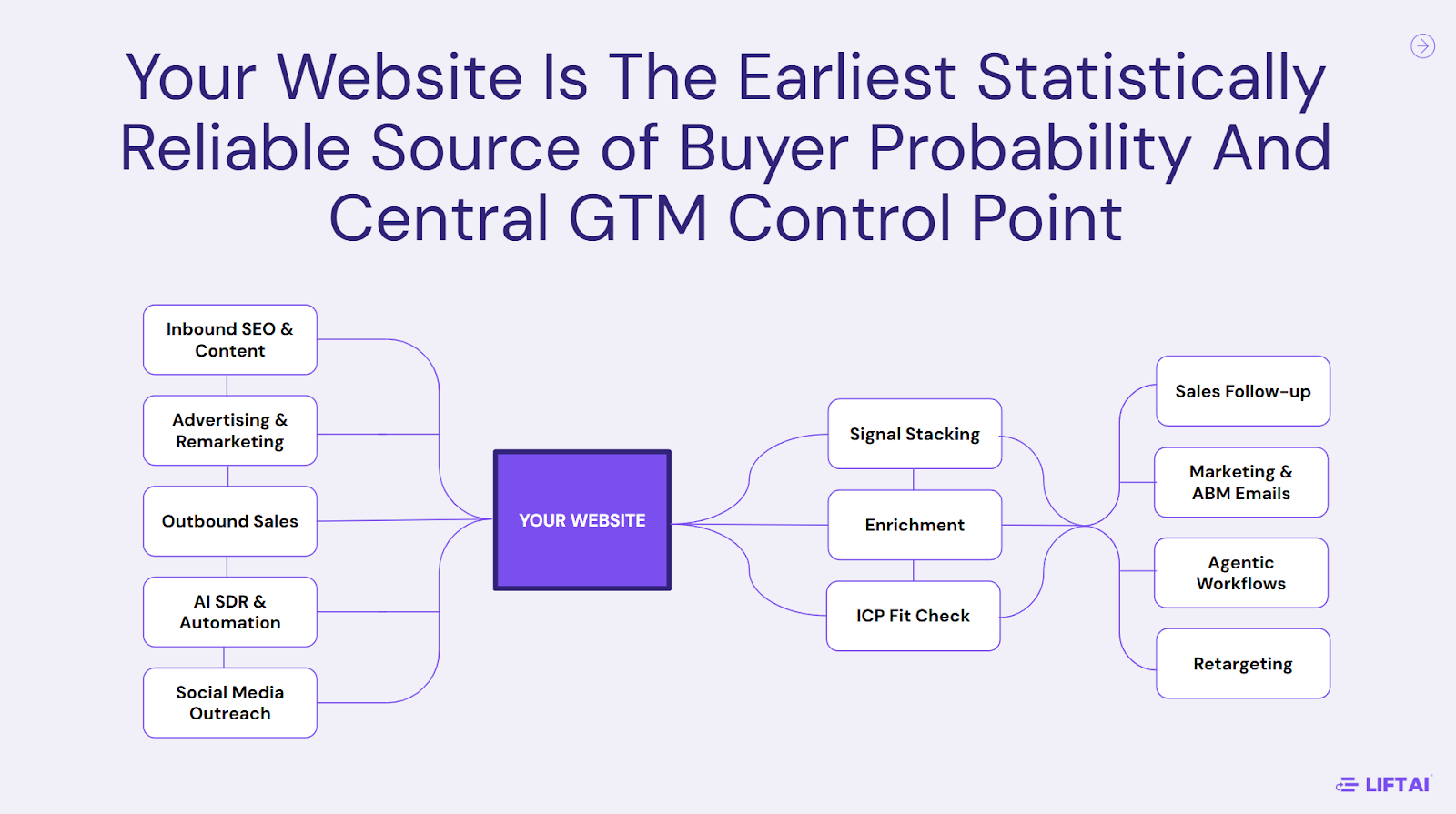
Every GTM channel eventually drives to one destination.
- Ads → Website
- Outbound → Website
- Email → Website
- Content → Website
- Events → Website
Which means every month, sales-ready buyers visit your website.
- Some are researching.
- Some are evaluating.
- Some are looking for support.
- Some are ready to buy.
But most GTM systems treat them exactly the same.
The core problem is that today’s GTM systems cannot accurately translate actual buyer behavior on your website into a reliable measure of buying probability.
Unlike external signals — which infer intent from fragmented activity — your website captures direct behavioral evidence of buying research in real time. Every page view, return visit, scroll depth, and navigation path adds context to what a visitor is trying to accomplish.
Which means the single richest source of buyer behavioral context in your entire GTM stack is already sitting right in front of you, but without that interpretation layer your website’s behavioral context is largely untapped.
When interpreted correctly, that behavioral context makes something possible that most GTM stacks lack: a statistically grounded measure of buyer probability for every website visitor.
How Website Behavioral Context Enables Buyer Probability
A signal tells you something happened. A pricing page view.
Context interprets those signals and patterns to tell you what they mean.
But probability tells you a statistically significant prediction of what's likely to happen next based on that context.
Specifically, whether every individual visitor (not an account) on your website is demonstrating buying behavior, no matter what page they’re on (not just the pricing page).
In truth, buying behavior unfolds through complex navigation paths, return visits, time between interactions, scroll depth, content consumption patterns, and hundreds of subtle micro-behavioral signals that reveal how a visitor is progressing through their journey.
Here are a few of the structural characteristics that make website behavioral context uniquely capable of revealing the buyer probability of your website visitors:
- Buying Behavior: Your website is where research and curiosity become observable behavioral patterns, rather than inferred intent from outside events or simplistic activity like pricing page views.
- Data Density: Unlike individual signals such as pricing page views or fragmented signals gathered from multiple sources, the behavioral activity on your website reveals patterns across hundreds of micro-signals, all captured within the same visitor journey.
- Proximity to Revenue: Your website is the final step before a visitor becomes a customer. That proximity makes the behavioral patterns observed there the closest available predictor of an actual purchase decision.
- Statistical Significance: The combination of behavioral visibility, data density, and revenue proximity creates the conditions required for true probability modeling.
- First-Party Advantage: All website behavioral data is first-party data owned by you — invisible to competitors and increasingly valuable in a world of growing data restrictions and signal commoditization.
Together, these characteristics can transform your website from a passive brand destination into the richest intelligence environment in your entire GTM ecosystem. That would also make your website a “central control point” for your GTM activity.
But this is where most GTM systems hit their limit.
Because they lack the ability to interpret the full behavioral context of every website visitor and convert it into reliable buyer probability scores.
Unlocking that intelligence requires a highly specialized AI-driven technology - and that technology is Lift AI.
The Missing Layer GTM Stacks & AI Agents Need: Lift AI Website Buyer Probability™
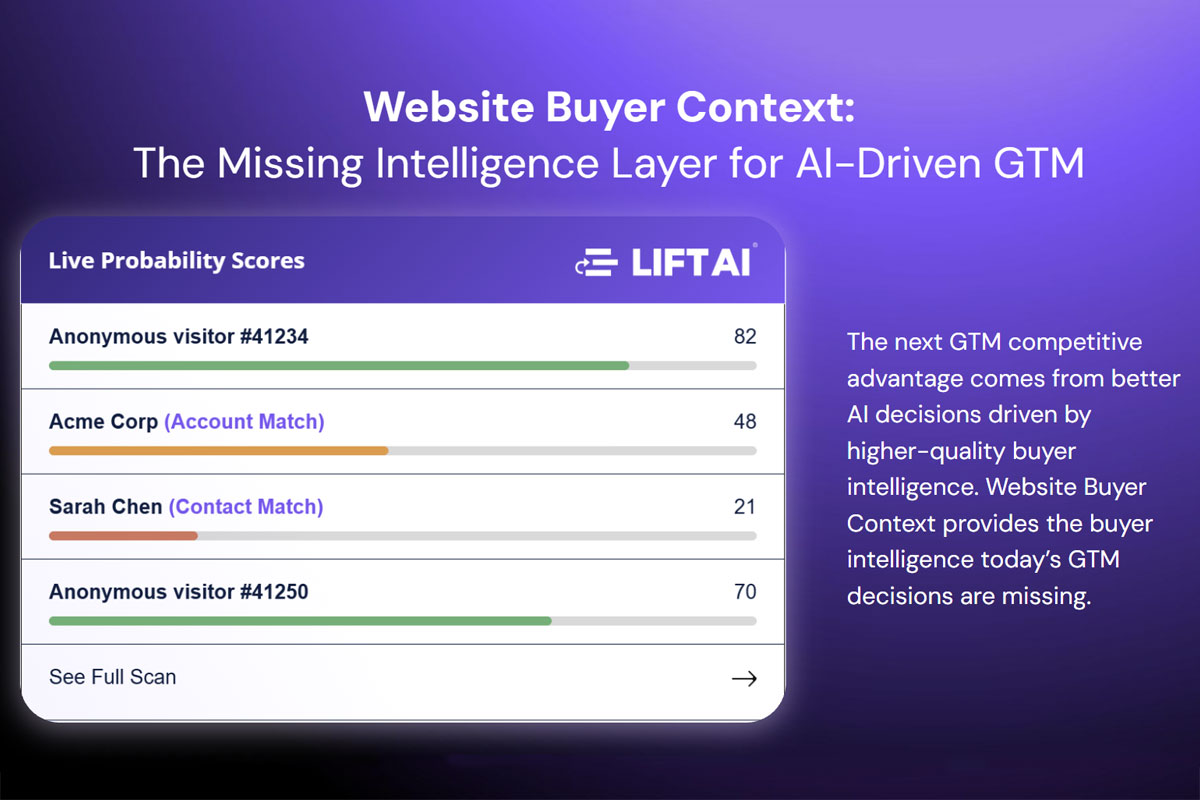
Lift AI reveals the buying probability of every individual website visitor - in real-time - by combining hundreds of micro-behavioral buying patterns into a single probability score.
- [Anonymous Visitor #41234]: 72 High Probability
- [Account Match Visitor: Monday.com]: 48 Medium Probability
- [Contact Match Visitor: John Smith]: 28 Low Probability

Built over the past 15 years and trained on billions of enterprise website visits and millions of sales, Lift AI’s machine-learning model identifies website visitor behavioral patterns on your website that correlate directly with revenue.
No analyst decides which signals matter, and no LLM tries to infer buying intent based on conversations. Lift AI’s model finds the patterns between behavior and revenue itself.
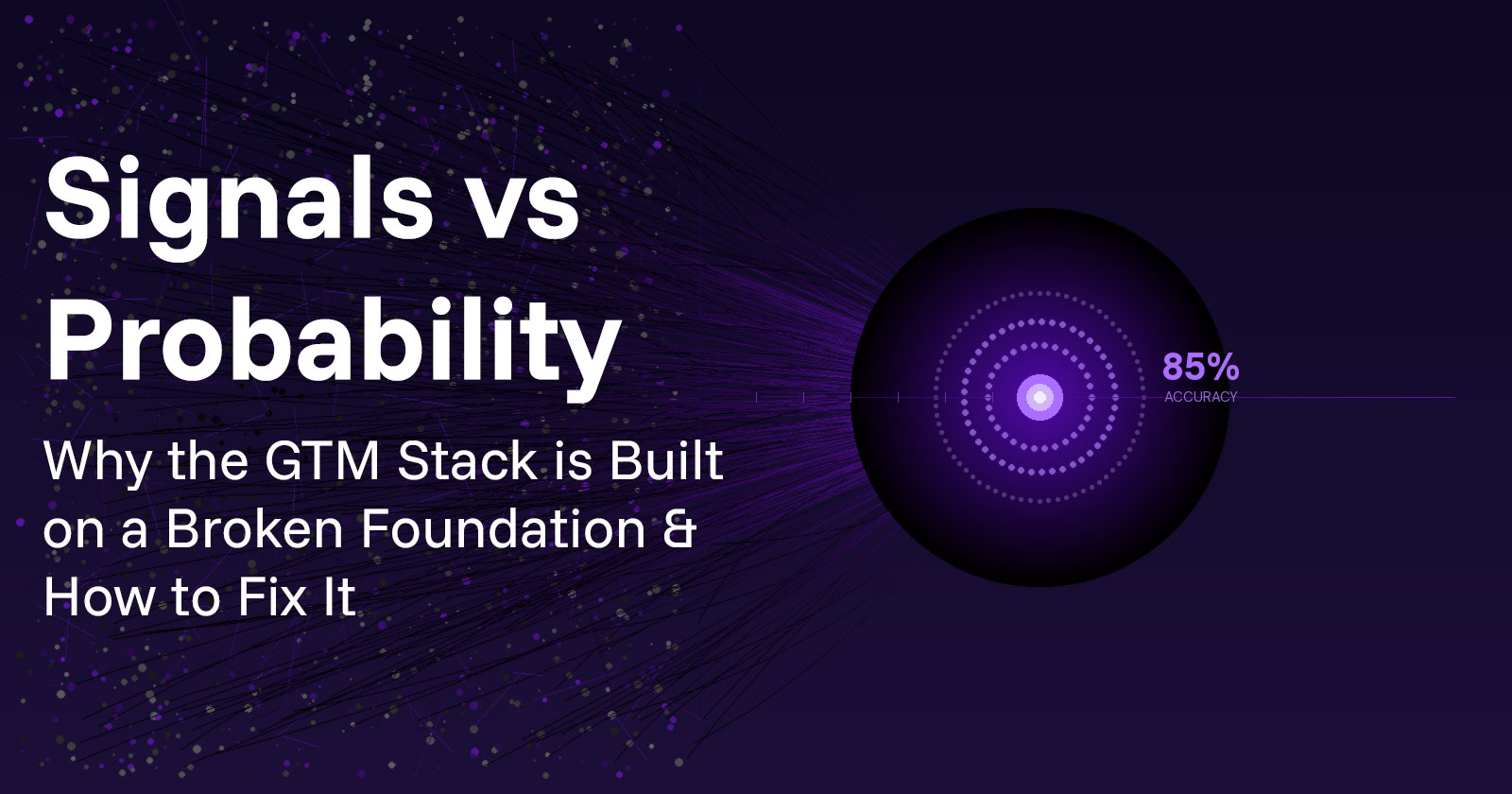
The result is a model free from human bias, achieving over 85% accuracy compared to an industry average below 20%. And we have the data to prove it.
"We moved away from a page-specific approach and moved to a Lift AI behavioral approach. For example, when people visit our pricing page they're not always going to be high intent… doing this doubled our SDR conversation to opportunity rate and doubled our opportunities created in the quarter!”
- Tim Ozmina, Head of Demand Generation and Digital Marketing @ Boomi
This is the ONE missing intelligence layer in most GTM stacks.
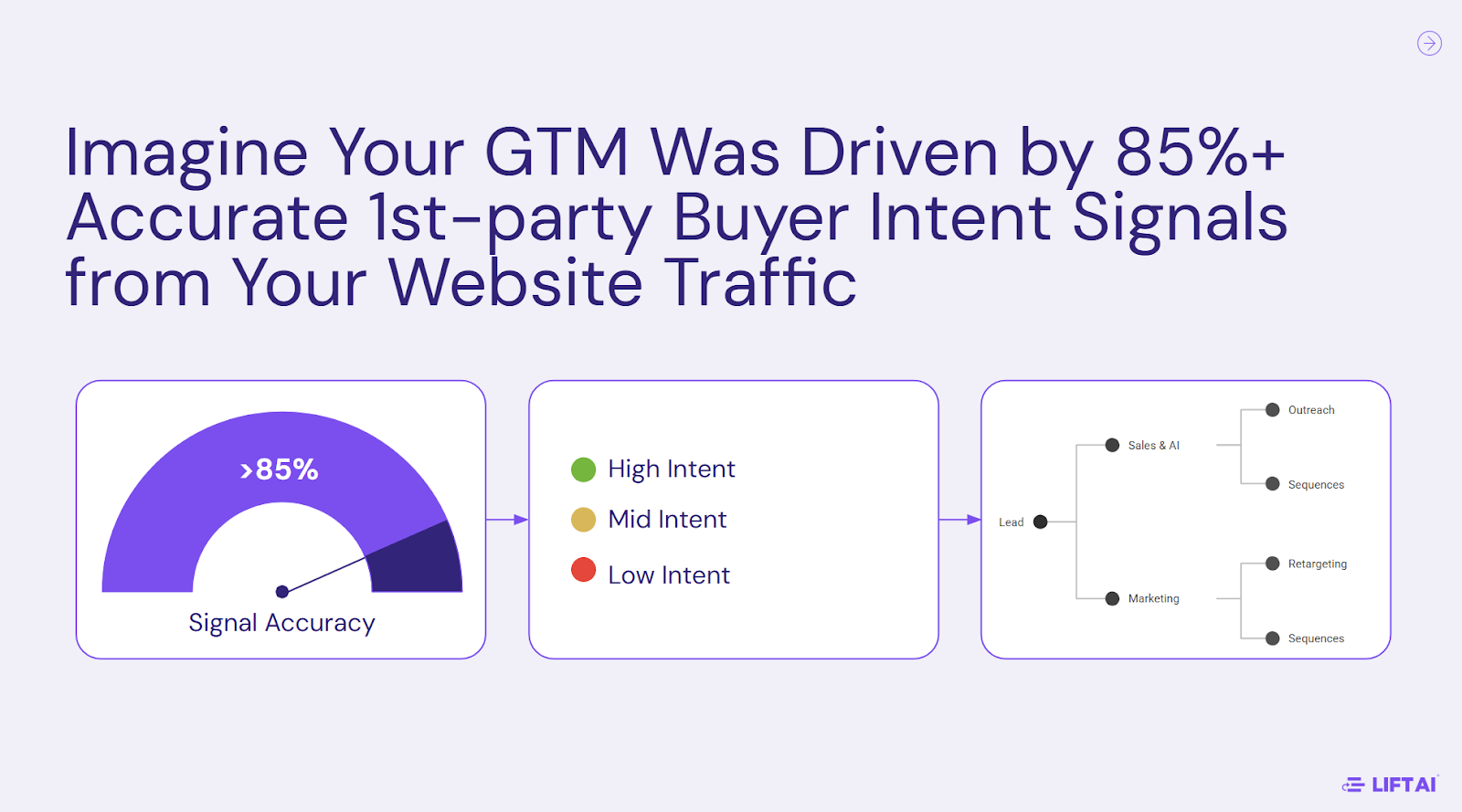
Imagine driving every GTM motion with a reliable, real-time measure of actual buyer probability — CRMs, marketing automations, ad platforms, sales workflows, and AI agents — all acting on which website visitors are important right now and exactly how to customize engagement.
This is the breakthrough Lift AI was built to deliver. By going far deeper into website visitor behavioral data than any other tool and turning your website into a GTM growth engine.
And not only does it help you prioritize your GTM activity with precision, but it unlocks the anonymous website visitors that currently have no useful or actionable signals.
Lift AI Unlocks The Revenue Hiding In Your Website Traffic
Remember how most signals are predicated on an Account or Contact match?
That means 70% to 95% of your website visitors remain completely anonymous.
They arrive, research, evaluate solutions and then leave — without you ever knowing who they are, what company they represent or which of them may be ready to buy right now.
Traditional GTM systems simply have no way to accurately interpret your website visitors’ activity, leaving a massive amount of pipeline and revenue on the table.
This is your biggest GTM revenue gap - and it’s time to fill it.
Lift AI works across 100% of your website traffic — anonymous visitors, known accounts and identified contacts alike.
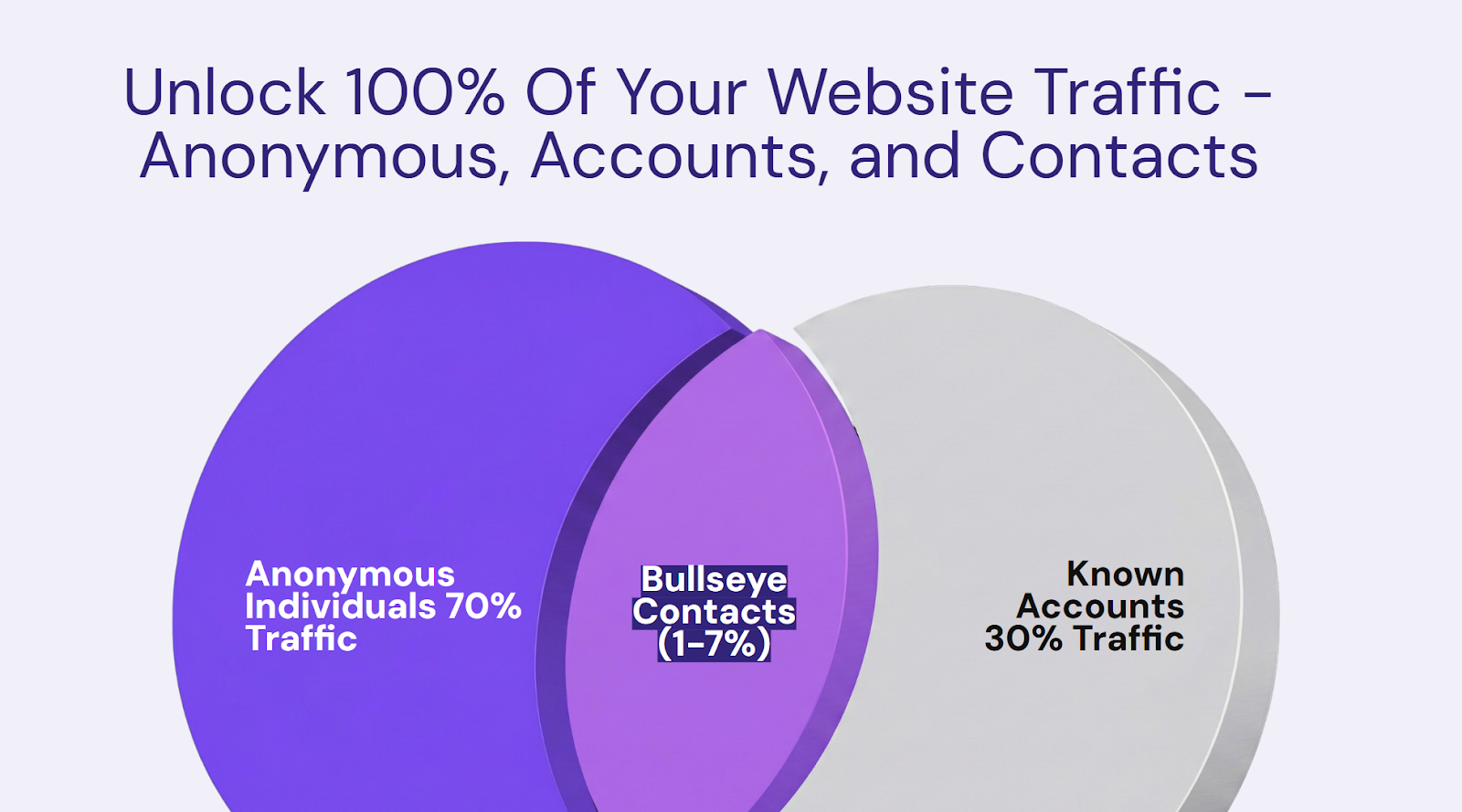
While most signal platforms operate primarily at the account level, Lift AI evaluates the buyer probability for each visitor.
This gives your GTM stack actionable intelligence at the level where buying decisions actually occur: the individual buyer, not just the organization.
That individual-level precision is especially important for AI agents, which usually operate at the contact level rather than accounts.
Because Lift AI scores every individual visitor - your entire volume of previously invisible website traffic becomes a reliable and repeatable source of pipeline and revenue.
What Becomes Possible With Probability (With Proof)
When buyer probability is the foundation rather than an afterthought, your entire GTM motion changes from activity-based deployment to probability-based deployment:
Anonymous traffic becomes visible and actionable pipeline.
- Intelex discovered that 56% of their website pipeline was coming from anonymous visitors - people who would have been completely invisible under a traditional signal-based approach.
Marketing segments and activates Accounts with precision.
- Payscale added individual Lift AI scores to Account Stages in 6sense and saw 19x more conversions within their highest-performing 6Sense segment (narrowing 151,475 6Sense "Purchase" Stage accounts to 2,307 high probability accounts), enabling them to prioritize and focus GTM resources much more accurately and effectively.
Sales finds and prioritizes the right Contacts at the right time.
- RealVNC saw 14.4x more revenue from high-probability contact-matched visitors compared to low-probability form fills. This is not only sharper prioritization, but unlocking a greater volume of sales-ready leads ready to convert.
AI agents are grounded in accuracy instead of noise.
- Boomi doubled the rate at which SDR conversations converted to pipeline after grounding their AI agents in probability scores rather than raw page-based signals.
Revenue, pipeline, and ROAS increase, CAC decreases.
- By targeting high-probability visitors instead of all visitors (too broad and vague) or just pricing page visitors (too narrow and inaccurate), Fluke Biomedical increased their revenue per website visitor by 345%.
- RealVNC decreased their retargeting Cost Per Lead by 67% simply by targeting high probability traffic
ONE Score. Your Entire GTM Stack.
Lift AI isn't another point solution in the tech stack. It's a Probability Layer - a single, accurate, intelligent input that feeds every rep, tool, and agent.
- Instead of routing every pricing page visitor to sales and contact enrichment agents, your platform engages only high-probability buyers — saving time, costs, and frustration while unlocking opportunities across every page to focus your enrichment, agents, and GTM resources on the visitors most ready to convert
- Instead of building retargeting audiences from “all visitors,” ad platforms can segment by buyer probability segments to dramatically improve ROAS and reduce CAC.
- Instead of chat asking the same qualifying questions to everyone, it adapts instantly to buyer probability level (e.g. fast-tracking high probability visitors to sales, and deflecting or nurturing low probability visitors).
Lift AI is so powerful it can be used for anonymous visitors on its own, and you can layer other signals on top for known accounts and contacts to extract maximum value and additional context from them.
The foundation of GTM is ONE score you can trust — and a stack you can finally build with confidence on top of.
This is critical as AI execution explodes in the market, because your competitive advantage becomes the accuracy of what’s feeding it based on 1st party website data - allowing you to find and prioritize buyers before your competitors do, while taking full advantage of the scale offered by AI and agents.
Ready To See The Buyers Hidden In Your Website Traffic? Get Your Free Website Buyer Probability™ Scan Today.
In a world where GTM leaders forecast years of signal-based orchestration evolution, you can get an accurate Website Buyer Probability Score™ today with Lift AI.
Start with a free 30-day Website Buyer Probability™ Scan - a precise breakdown of your website traffic and a clear picture of what to do next to convert them into pipeline and revenue.
Installation takes 5 minutes and no manual rules to set up (it’s pre-trained and ready to go for your website).
Just buyer probability, grounded in data, ready to power everything else in your GTM stack.