New data from Boomi, RealVNC, and Loopio reveals that when you add buyer probability to the signals you already have, everything downstream changes — and the results are dramatic.
Something unexpected happened when we started integrating Lift AI's buyer probability scores into HubSpot and Marketo.
We've been identifying which website visitors are likely to buy based on behavioral patterns for years, regardless of whether they're anonymous or known, to help companies transform their website chat into a revenue-generating machine.
But recently, we built integrations with Hubspot, Marketo, and Salesforce, and we began to see our customers' data in a way we hadn't before.
And the numbers stopped us cold. Because what was hiding inside the form fill changes how the entire GTM stack should work.
What Boomi Found Inside Their Form Fills
Boomi, the enterprise integration platform, ran Lift AI across 2,299 form submissions over 30 days. Every one of these visitors had actively raised their hand — filled out a form, requested information, expressed interest. By any standard GTM playbook, these are qualified leads.
But when each form fill was scored by buying probability at the moment of submission, a massive gap appeared:
High-probability form fills converted to opportunities at 5.48%. Low-probability form fills converted at 1.67%.
Same form. Same website. Same sales team. 3.2x difference in outcome.
This wasn't a Boomi anomaly. At RealVNC, high-probability form fills generated 4.4x more revenue than low-probability ones. At Loopio, the gap was 4.68x.
The pattern was consistent: form fills aren't as accurate a buying signal as is universally assumed.
Instead, they're a spectrum — and without probability scoring, teams have always treated the entire spectrum the same.
And that’s why probability changes the game for everyone.
Why This Matters Right Now
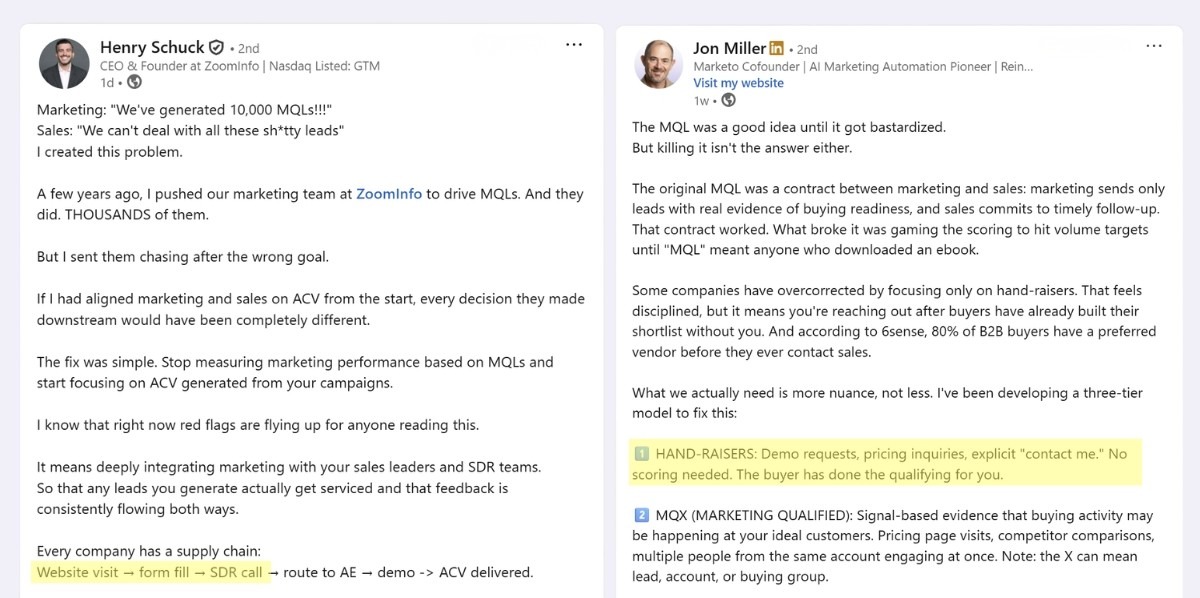
Some of the sharpest minds in GTM are building frameworks around the signals that enter the pipeline. Henry Schuck recently described the GTM supply chain as: website visit → form fill → SDR call → route to AE → demo → ACV. His point that marketing should be measured on ACV delivered, not lead volume generated, is exactly right.
Jon Miller has proposed a tiered model where hand-raisers (demo requests, pricing inquiries, contact forms) sit at the top because, as he puts it, "the buyer has done the qualifying for you."
These are smart frameworks from two experienced operators who are amongst a handful of elite pioneers in the GTM space. And the instinct behind them is correct: revenue teams should optimize the full pipeline from visit to ACV, not just the top of it.
But here's what the Boomi data adds to the picture: the form fill isn't the golden buying or qualification signal we thought it was.
A high probability visitor who fills out a demo request form is fundamentally different from a low probability one. Both show up in the CRM identically. Both get the same SDR follow-up. Both consume the same resources.
But one converts at 3.2x the rate of the other.
This isn't a problem with anyone's framework. It's a missing layer of intelligence that makes every framework work better.
What Changes When You Add Probability
To understand what changes, it helps to understand what buyer probability is — and how it differs from the signals most GTM stacks already run on.
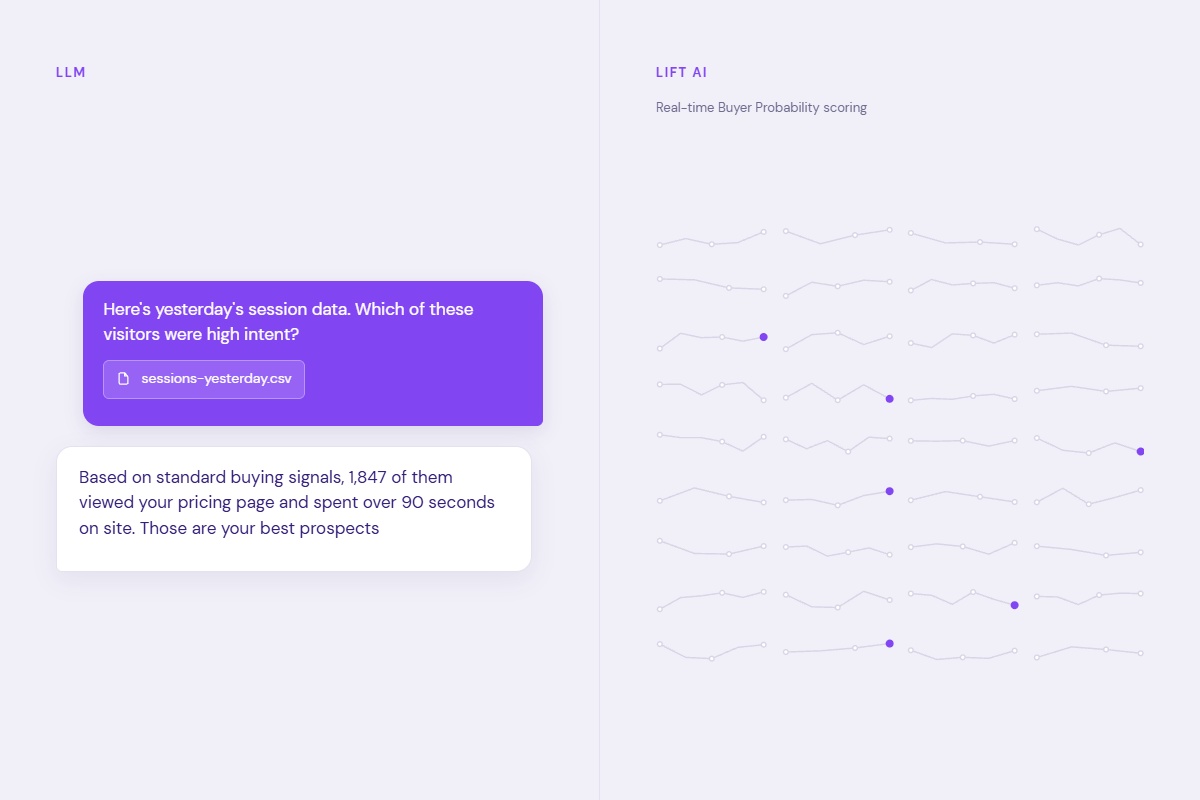
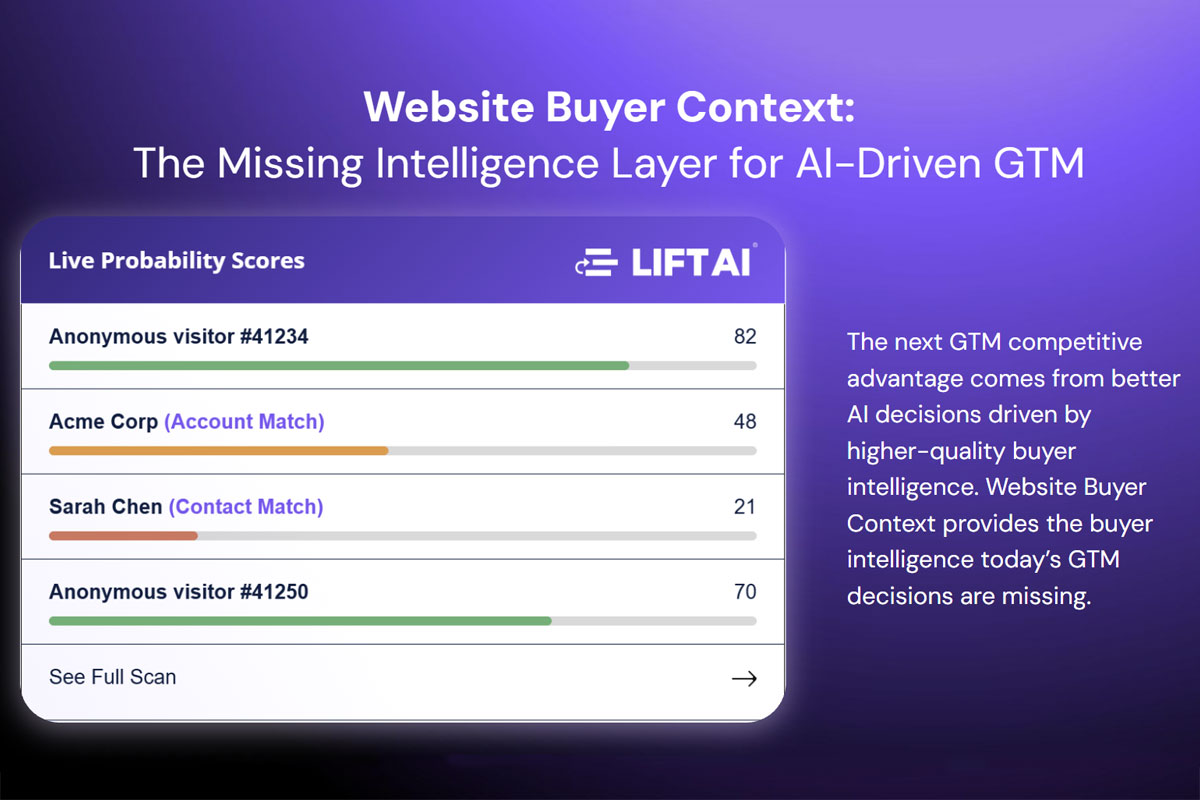
Most signals tell you a raw observation about something that happened: a page was visited, a form was filled, a keyword was searched related to your industry. Lift AI's buyer probability score tells you what it means and what's likely to happen next. It analyzes the full behavioral context of every website visitor in real time — the navigation path, clicks, scrolls, hesitations, content classification, time on page and between interactions, and many more — to produce a single score that reflects genuine buying probability. For every visitor. Including the 70–95% who are completely anonymous.
When Lift AI's Website Buyer ProbabilityTM scores flow into HubSpot, Marketo, Salesforce, or any downstream system, the data doesn't replace existing signals — it sharpens them. Here's what that looks like in practice:
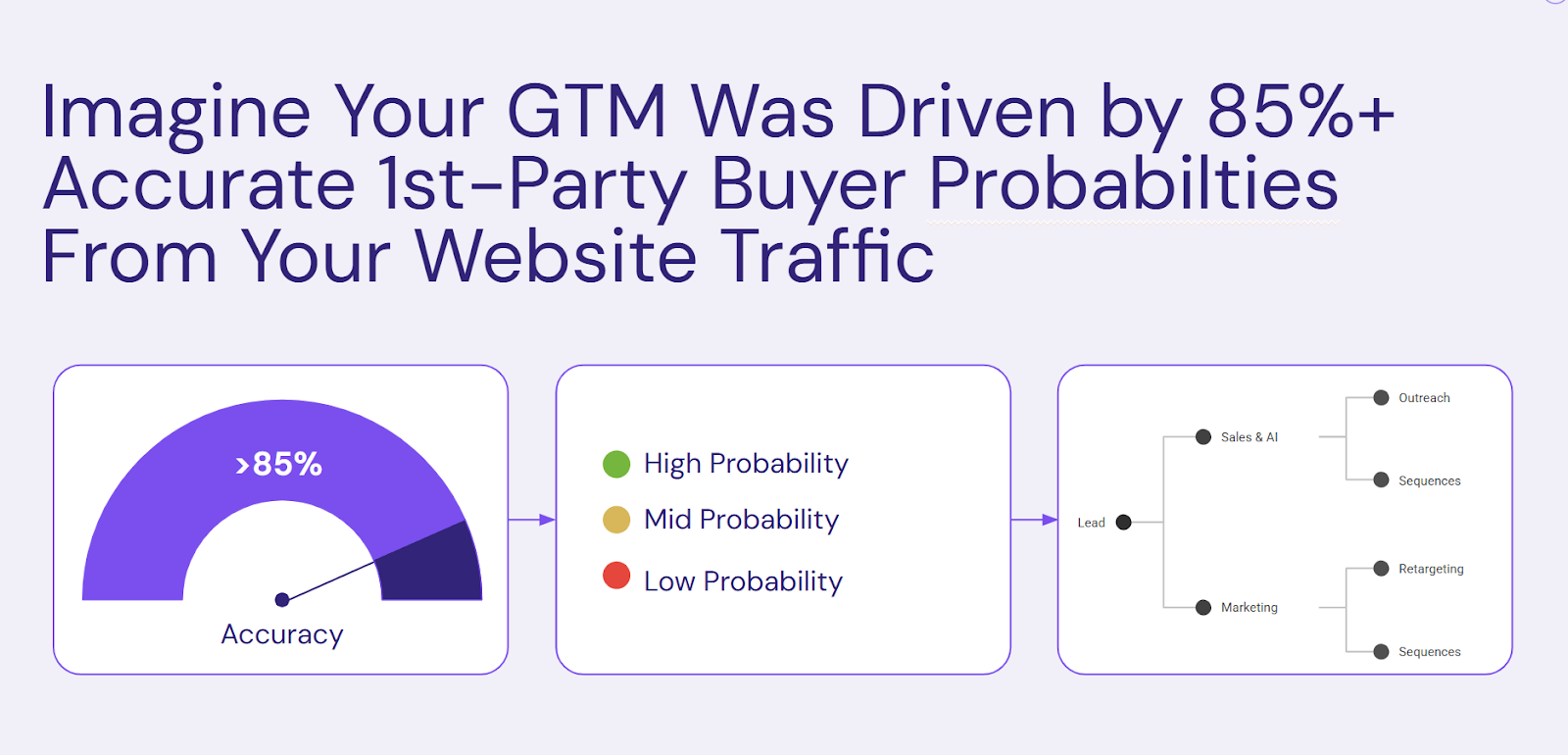
Form fills get prioritized by probability, not just by timestamp. Instead of routing all form fills to SDRs equally, high-probability submissions go to live reps immediately while low-probability ones enter automated nurture sequences. At Boomi, this contributed to a 3.2x more high probability form converting to pipeline than a low probability form.
Matched accounts gain an individual-level readiness signal. Account-level intent tells you a company is in-market. Probability tells you which individual from that company is demonstrating buying behavior right now. At RealVNC, high-probability matched visitors generated 14.4x more revenue than low-probability form fills — meaning the visitors who didn't fill out a form were often more valuable than those who did.
Anonymous visitors become visible and actionable. On average, 70% of website traffic is anonymous. Without probability scoring, these visitors are invisible to every tool in the stack. Boomi discovered that 58% of their website pipeline came from anonymous visitors. Payscale found it was 54%. Chronus found that the 0.05% of anonymous visitors scored as high-probability by Lift AI produced as much pipeline as the 27% who were fully identified through their ABM tools.
ABM systems get dramatically more precise. Payscale layered Lift AI's individual-level probability scores on top of their 6sense account stages. The result: 151,475 accounts that 6sense classified as "Purchase Stage" were narrowed to 2,307 high-probability accounts — and conversions in the highest probability segment jumped from 0.5% to 10.6%. That enables prioritization on a segment with 19x more conversions by adding one layer of individual behavioral probability on top of account-level intent.
Retargeting spend concentrates on buyers, not browsers. RealVNC reduced their cost per lead by 67% by building retargeting audiences from high-probability segments instead of "all visitors." Same ad budget, pointed at the right people.
Chat and AI agents engage with precision. Instead of firing the same qualifying questions at every visitor, chat platforms can adapt instantly to probability — fast-tracking high-probability visitors to sales conversations and deflecting or nurturing low-probability ones. Across Lift AI's Drift clients, this approach produced a 9x increase in conversations turning into pipeline.
The Opportunity for the GTM Ecosystem
Here's what excites us most about this data: buyer probability doesn't compete with any existing GTM tool. It makes every tool in the stack more effective.
HubSpot's workflows become probability-informed. Marketo's scoring models gain a behavioral accuracy layer they didn't have before. Chili Piper's routing becomes probability-based — high-intent form fills go to live booking, low-intent goes to nurture. Salesforce's Agentforce agents make decisions grounded in 85%+ accurate readiness signals instead of page-view rules.
The Gartner Magic Quadrant for Revenue Action Orchestration recently defined a market of vendors — Clari, Gong, Outreach, Salesforce, HubSpot, ZoomInfo — all building systems to orchestrate seller actions. But Gartner also flagged a gap: "systems without adequate context may generate inaccurate or hallucinated responses." That context gap is exactly what buyer probability fills.
We see Lift AI as a probability layer that sits upstream of every platform in the GTM stack — not replacing signals, but interpreting them. Adding context to activity. Adding probability to identity. Adding accuracy to automation.
The companies already using it — Boomi, RealVNC, Okta, Fluke Health, — aren't ripping out their existing stacks. They're adding one layer of intelligence that makes everything else work harder.
Same Traffic. Same Stack. Different Foundation.
Henry Schuck's supply chain — visit → form fill → SDR → AE → ACV — is the right framework. The question is: what if every step in that chain ran on probability instead of assumptions?
What if the form fill was scored before the SDR picked up the phone? What if the routing logic knew which form fills were 3.2x more likely to convert? What if the matched visitors who never filled out a form — but were behaviorally ready to buy — were surfaced to sales anyway?
That's not a different supply chain. It's the same supply chain, running on a better input.
Jon Miller is right that hand-raisers deserve priority. The data simply shows that hand-raisers aren't all equal — and when you can see the difference, your entire GTM motion gets more efficient.
The shift isn't from signals to probability. It's from signals alone to signals plus probability. And when probability is the foundation, everything built on top of it compounds.
See what buyer probability looks like across your own traffic. Get a free 30-day Website Buyer Probability scan — one snippet of code, live in 5 minutes, no commitment.
For a deeper look at why behavioral context is the key to buyer probability and how it transforms AI-driven GTM, read our foundational piece Signals vs Probability here.