



The behavioral context behind each Website Buyer Probability Score also exposed a 3.2x gap in form fills, a pricing page illusion, and an anonymous pipeline no identity tool could see.
“We moved away from a page-specific approach and moved to a Lift AI website buyer behavior approach. Most people who visit our pricing page are not high probability buyers — but we found high probability buyers all over our website that we were missing.”
- Tim Ozmina, Head of Demand Generation and Digital Marketing, Boomi
Boomi replaced traditional page-based chat rules and uniform form routing with Lift AI's Website Buyer Probability Scores — adding real-time behavioral context to every visitor — to unlock hidden pipeline and revenue from anonymous visitors, and by being the first one in the deal, transformed website conversion rates and GTM revenue.
Boomi Tested The Three Assumptions Most GTM Teams Don't Question
Most GTM teams operate on three defaults that have hardened into industry-standard practice:
- Every form fill goes to sales as a priority lead
- Identified Accounts and Contacts are the key to website pipeline and revenue
- Chat engagement is best triggered on “high-intent" pages like pricing
These assumptions treat a single action or identity as proof of buying readiness. The logic is so embedded in the modern GTM stack that very few teams stop to question the predictive value of these isolated data points. .
Boomi's team did the test, and here’s what they found:
- Form fills should be treated and prioritized differently — there’s a 3.2x revenue gap hiding in them
- Anonymous visitors accounted for 90.1% of their website traffic and 94.4% of their chat revenue, outconverting all website visitor form fills
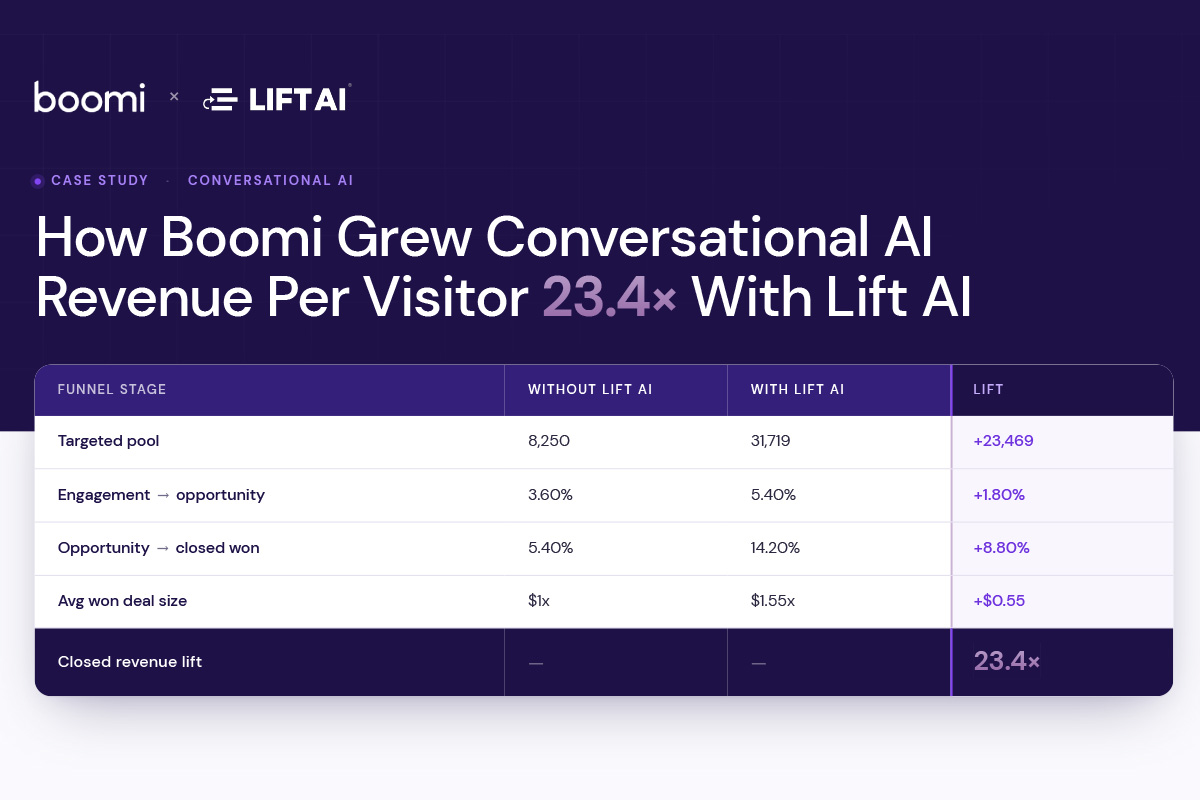
- Deploying chat on all pages (not just pricing) - using Buyer Probability Scores - increased revenue for chat visitors by 23.4x
Their hypothesis ran against the conventional wiring: that the totality of a visitor's behavior before they submit a form or engage in chat, and regardless of their identity, is a stronger predictor of buying readiness than the action itself.
However, Boomi’s test needed to more accurately predict which website visitors were sales-ready, and which weren’t. So they installed Lift AI's Website Buyer Probability Scores on their website, which analyzes hundreds of behavioral signals for every visitor in real time to predict buyer readiness with over 85% accuracy per score, even for anonymous visitors. The scoring model was pre-trained on 15+ years of behavioral data including billions of analyzed web journeys and millions of sales.
Now, after accumulating eighteen months of deployment data, the hypothesis has been validated decisively — and the results expose a major structural flaw in how Boomi, and most B2B GTM teams, are currently treating chat, form-fills, and anonymous website visitors.
Part 1 - The 90/10 Blind Spot: Where Boomi’s Revenue Was Actually Hiding
Before Lift AI, Boomi could only identify a small fraction of its website visitors through traditional identity resolution systems. Out of every 100,000 website visitors, only 9,890 (9.9%) were identified as known accounts or contacts - and those identified visitors generated just 5.6% of chat-driven revenue.
After Lift AI, Website Buyer Probability Scores enabled Boomi to identify and engage high-probability buyers across the remaining 90.1% of anonymous website traffic using real-time behavioral context. These previously invisible visitors accounted for 94.4% of Boomi’s chat-driven revenue over the past 18 months.
The numbers below are per 100,000 monthly visitors.
Traffic & Revenue Composition — Anonymous vs Identified
Part 2 - The Pricing Page Illusion
The most common proxy for buying intent in B2B is the pricing page. Boomi’s data dismantles it:
Of the 4,400 visitors (4.4% of total traffic) who visited the pricing page, only 349 were High Probability buyers (7.9%). The remaining 92.1% of pricing page visitors were not sales ready, resulting in wasted sales resources. Meanwhile, the vast majority of High Probability visitors (10,237) strewn across the rest of the website were being missed entirely by the old page-based rules.
Buyer Probability Distribution by Pricing Page
Part 3 — The 3.2x Pipeline Gap Hidden Inside Every Form Fill
Standard GTM inbound logic treats every form submission the same: the visitor identifies themselves and declares their “intent” for sales, so the SDR prioritizes them. Priority is set by recency and form field data, not by the behavioral context or where they are in their buying journey.
Boomi recently layered Lift AI’s Website Buyer Probability Score onto every form submission using their Marketo integration — with each form fill scored and segmented by the visitor’s buyer behavioral context, based on all their website sessions before they filled out the form.
Across 2,299 form fills over a 30-day window, the conversion-to-opportunity rate for each Buyer Probability Segment showed a dramatic difference:
Bottom line: High Probability form fills converted to opportunities 3.2x more often than Low Probability ones. Same form. Same landing page. Same sales team. The only variable was the behavioral context the visitor carried into the submission — and that context accounted for most of the difference in outcome.
What This Revealed About Boomi’s Inbound Funnel
Inside Boomi’s inbound funnel, the 3.2× conversion gap was invisible to standard MQL lead scoring models and SDR prioritization queues. Which means their Low Probability segment was absorbing the same rep time and costs as High Probability buyers.
Those were not just hard costs either — it includes massive opportunity costs - with high-probability submissions waiting in the same queue and being missed — where every minute of delay gives competitors a better chance of poaching them.
How Boomi Can Act on the 3.2x Gap
Once Lift AI’s Probability Score is attached to every submission, the routing logic follows naturally. High and Mid Probability form fills can be fast-tracked to immediate sales follow-up. Low Probability submissions can be deprioritized and given more automated nurturing. This creates immediate impact and measurable results for your sales conversion rates.
Part 4 — With Buyer Probability Scores, Anonymous Website Visitors Converted 1.75x More Often Than Form Fills
Conventional GTM logic treats form fills as one of the strongest indicators of buying intent — and they are an important source of pipeline for most GTM teams. But after implementing Lift AI’s Website Buyer Probability Scores, Boomi found that high-probability anonymous website visitors converted into opportunities at a much higher rate than visitors who submitted forms.
By prioritizing chat engagement using Buyer Probability Scores, Boomi was able to identify which anonymous visitors should be engaged with chat, how they should be routed, and which visitors should not be engaged with chat at all — improving pipeline quality, conversion rates, and revenue outcomes.
If form fills are the high-intent signal the market believes them to be, they should outperform anonymous chat at every level.
They don’t.
Anonymous visitors who engage in chat outconvert visitors that fill out a form.
Anonymous visitors with no name, no email, no company record in the CRM, and no IP lookup — converted to opportunities 1.35x better than form fills overall, and 1.75x better for the High Probability segments.
The difference is even greater between extremes — a High Probability anonymous chat conversation (9.61%) converts 5.75x higher than Low Probability form fills, demonstrating a significant opportunity from hidden traffic that sales and marketing resources can be reallocated towards.
Three Reasons This Happens
Chat captures buyer interest at the peak. A form fill is followed by latency — the rep gets the notification, queues the outreach, makes contact. Hours pass. Days, sometimes. Intent decays the entire time. Chat captures the buyer in real-time, while their interest and engagement with your brand are at their highest, and before they tab to a competitor. Lift AI identifies the moment. Chat captures it.
Willingness to fill out a form isn’t the same as readiness to buy. Many people who submit forms are not active buyers — researchers, students, competitors, content downloaders, or early-stage evaluators. A form submission signals interest, but much more behavioral context is needed to predict buying readiness.
Anonymous visitors are underserved. As Boomi’s data showed, anonymous visitors accounted for over 90% of their website traffic. Yet anonymous traffic typically receives little or no meaningful engagement because today’s GTM stack provides very little actionable data about anonymous website visitors.
Most GTM stacks are built around identified contacts — from ID reveal to CRM matching, enrichment, scoring and personalization. As a result, today’s AI-driven GTM systems route, score, and prioritize based primarily on the small fraction of website visitors that can be tied to known contacts, identified accounts, or form fills, while the anonymous majority remains largely invisible.
Any GTM stack that prioritizes sales engagement based on identification or form fills is operating on the smaller side of the pipeline. The anonymous majority — including visitors actively evaluating but have not yet raised their hand — will continue to be invisible and outside most sales and marketing workflows.
After Boomi was able to identify and prioritize the high-probability anonymous buyers using Lift AI, all their previously invisible traffic became a new stream of qualified pipeline and generated 94% of Boomi’s chat-driven revenue. And because competitors lack visibility into the anonymous buying behavior, engaging these buyers earlier creates a significant competitive advantage.
Part 5 — The 23.4x Closed Revenue Lift Hidden Inside Conversational AI
The same assumption that exposed the conversion gap in Boomi’s form fills was also behind their chat channel: that one action indicates buying intent. It assumes that visitors landing on “high intent” pages like pricing, product, and key landing pages must be closer to buying. The logic feels right, but it’s very misleading (and only engages a small portion of total traffic compared to site-wide coverage).
However, it’s the totality of all the behavioral context before and around those page views that indicates true buying probability — and because Lift AI’s score is exclusively derived from behavior, it doesn’t need specific page views or even visitor identity to know the probability of buyer readiness.
In fact, Lift AI scores reveal every opportunity on every page, whether the visitor is a known contact, account, or completely anonymous. That distinction matters because the majority of traffic on websites is anonymous, with no meaningful way to isolate, segment, and engage them.
For Boomi, anonymous visitors made up 91% of traffic — and accounted for 94% of the revenue from chat. The 9% of visitors who would be identified as an account or contact produced just 6% of revenue by comparison.
When Boomi replaced page-based chat triggers with Lift AI’s probability scoring, they changed who they engaged, the volume of visitors engaged (site-wide), and how those visitors were treated in conversation.
Below are the results from 18 months of chat data, normalized to 100,000 monthly visitors. Conversion baselines derived from 6 months pre-Lift AI vs. 18 months after.
High Probability visitors were routed to live reps as quickly as possible and greeted with fast-tracked, sales-based messaging. Mid Probability visitors were engaged with Conversational AI with instructions calibrated by score — qualifying, nurturing, or educating as appropriate until ready to hand to a live SDR.
Low Probability visitors were engaged almost entirely with automated Conversational AI experience.
This is all from the same website, same team, and with no process overhaul. The only structural change was the input driving the system: a more accurate read of visitor buying probability, derived from behavioral context instead of key page visits or visitor identity.
Behind the 23.4x Closed Revenue Number: Four Compounding Levers
The 23.4x closed revenue impact is not attributable to a single variable. Each lever compounds sequentially — each improvement multiplies the next:
Targeting expansion (3.84×). Page-based chat reached 8.25% of visitors per 100K — the fraction that landed on the ‘key’ pages. Site-wide behavioral scoring reached 31.72%, nearly four times as many. The incremental pool wasn’t lower-quality traffic, either. It was High and Mid Probability buyers who were strewn across the site. The page rules couldn’t see them. Lift AI could.
Engagement-to-opportunity rate (1.50×). The conversion rate improvement came from the quality of who was being engaged, how they were routed, and how they were treated in conversation. High Probability visitors were immediately routed to live reps for sales-based experiences. Mid Probability visitors got Conversational AI designed for their segment. One-size-fits-all chat was replaced with probability-matched engagement. Opportunity conversion improved from 3.60% to 5.40%.
Opportunity-to-close rate (2.63×). When pipeline originates from accurately-scored visitors, the opportunities reaching sales are qualitatively different: cleaner intent, earlier in the buying journey, and less competitive pressure. Close rate improved from 5.40% to 14.20% against the same team — no headcount increases or team upskilling.
Average won deal size (1.55×). Accurate probability scores surface buyers earlier in their buying journey — before filling forms and often before competitor framing has set the deal benchmark. Deals that start consultative rather than reactive tend to close at fuller value, with less discount pressure. The reps are more confident going into deals due to the accuracy of the score, which leads to better experiences. ACV rose 55% over the baseline across 18 months of closed-won data.
Compounding math: 3.84 × 1.50 × 2.63 × 1.55 = 23.4× closed revenue.
How Are These Numbers Verified?
Lift AI predicts the likelihood of a visitor converting to a buyer in bands of 5, so 0-5, 6-10…95-100.
To operationalize the scores, Lift AI that puts visitors into three buckets — High, Mid, and Low Probability — is only useful if the buckets behave differently in the real world. If High Probability visitors don’t actually convert at a meaningfully higher rate than Low Probability ones, the score isn’t telling you anything useful.
Boomi’s data shows the buckets do behave differently — dramatically so. Looking at chat conversion to opportunity: High Probability visitors converted at 9.61%. Low Probability visitors converted at 1.54%. That’s a 6.24x difference in outcome between the visitors the model called ready and the visitors the model called not ready. The difference is also evident in form fills, where the difference between High and Low Probability conversions was 3.2x.
This is what accuracy looks like in practice. A demonstrable gap in real downstream results, across 18 months of live production data.
Every deployment also includes a live technical accuracy dashboard — confusion matrix, precision, recall, F1 score, drift monitoring — updated daily, accessible to the client, and available for auditing at any time. This is continuous production validation running 24/7/365.
Part 6 — This Was Only One of Six Available Buyer Probability Plays
The 23.4x closed revenue multiple is from one Lift AI playbook - Convert Conversations Into Revenue.
But Lift AI can operate across six plays — all running on the same Website Buyer Probability Score.
The same behavioral context that drove Boomi’s chat results can drive other GTM motions, each compounding independently:
If you want to see results like this for yourself, sign up for a free 30 day Buyer Probability scan on your website to get started.
---
Methodology & Data Notes
All figures derived from production conversion data across 18 months of Lift AI deployment at Boomi. Chat performance metrics normalized to a 100,000 monthly visitor baseline for comparability. Conversion baselines from 6 months pre-Lift AI vs.18 months after. Form fill analysis covers 2,299 submissions over 30 days, scored at the moment of submission. Form Fill Tier conversion rates: High Probability 5.48%, Mid Probability 4.50%, Low Probability 1.67%. Anonymous chat vs. form fill comparison derived from the same deployment window. High Probability anonymous chat converted to opportunities at 9.61%; High Probability form fills at 5.48%. The 6.24× conversion differential referenced in the accuracy section is derived from the chat data: 9.61% ÷ 1.54% (High vs. Low Probability anonymous chat to opportunity). ACV impact (+55%) reflects actual closed-won deal data over 18 months, expressed as a multiple of pre-Lift AI baseline.
About Lift AI
Lift AI is the Website Buyer Probability layer for GTM. Our model was trained on 15+ years of behavioral data and billions of real buying outcomes — not analyst assumptions. We score 100% of website visitors in real time, including fully anonymous ones, with 85%+ proven accuracy. Lift AI surfaces the buyers no other tool can see and feeds behavioral context to your chat, CRM, MAP, retargeting, and AI agents.
About Boomi
Boomi is a leading integration platform as a service (iPaaS) provider, helping enterprises connect applications, data, and people across complex technology environments. Boomi’s GTM team operates in a high-consideration buying cycle where engaging the right buyers early is a meaningful commercial advantage.


