If you’re a CMO, CRO, or GTM leader, you’ve probably been told that intent data and signals are the fuel for your revenue engine.
And that with the right signals, your teams can know who’s ready to buy.
This is entirely true.
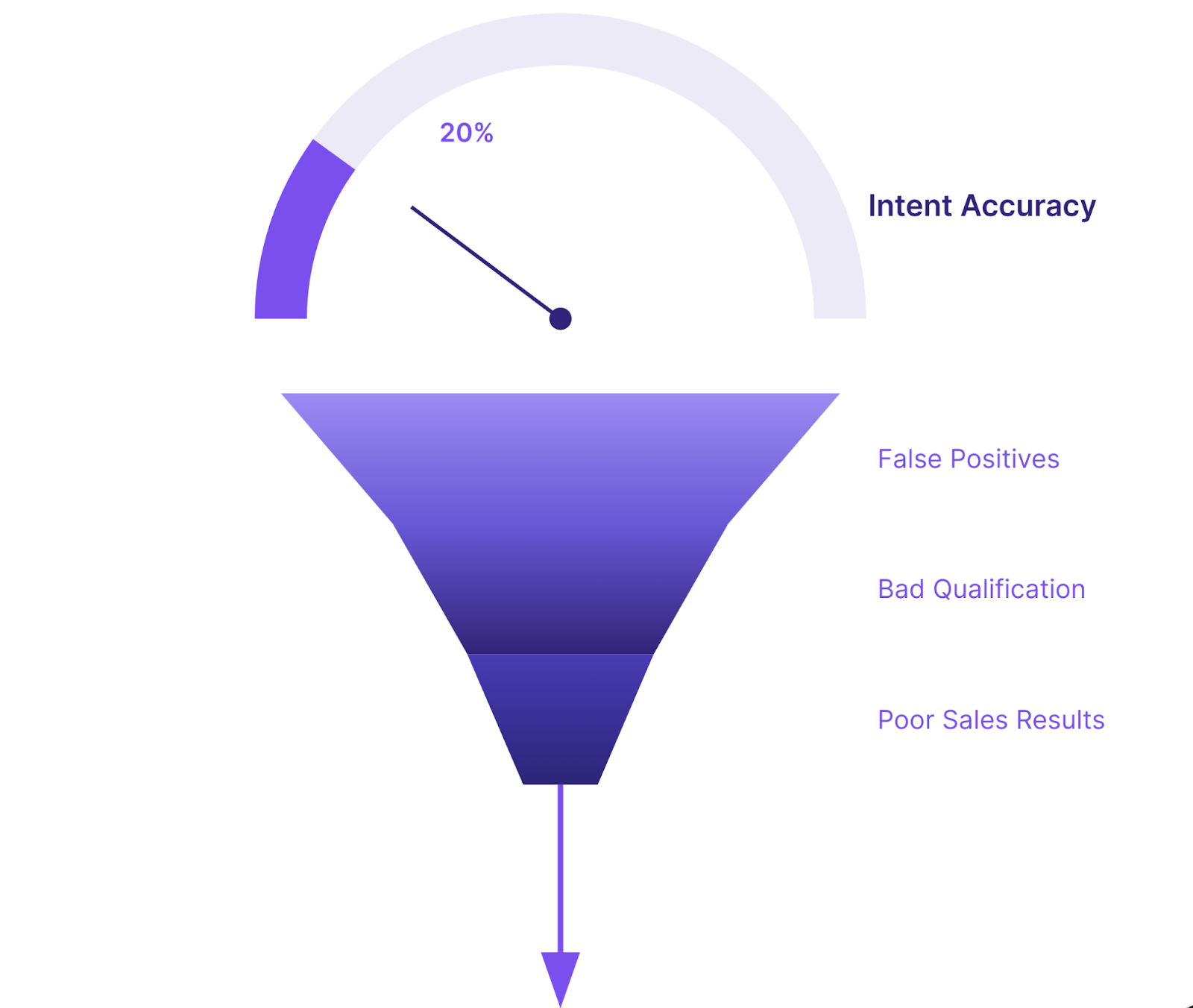
But here’s the dirty secret no one wants to admit: most intent data and signals are less than 20% accurate on average. Which means instead of fueling revenue, you’re bleeding revenue.
Forrester (Brett Kahnke):
“Despite all the benefits of intent data, too often the reality doesn’t meet the expectations. This is particularly true in sales.”

Meanwhile, An MIT study (Neumann, Tucker, & Subramanyam) found that off-the-shelf intent data segments performed:
“No better at reaching the right person than random prospecting”.

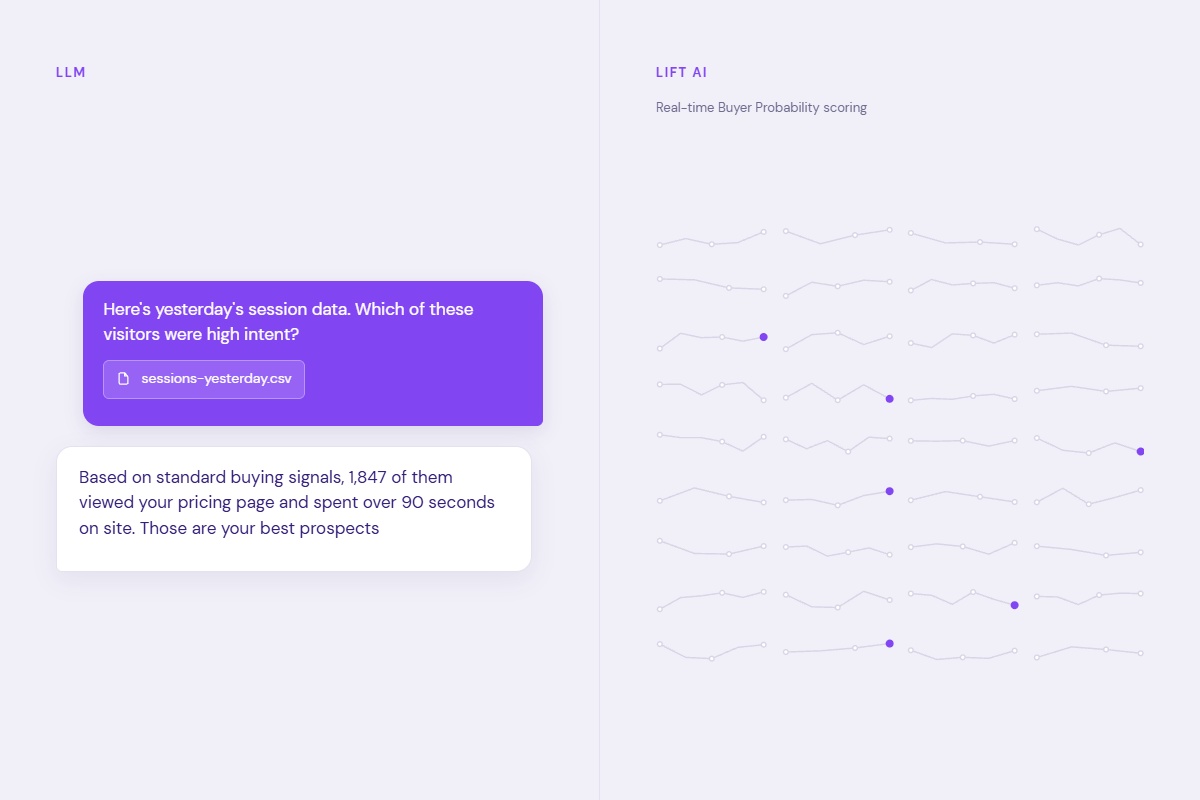
Our own studies back this up. One of the most popular intent signals on the market is “Pricing Page Views”. However we’ve found that
“88% of High Intent Buyers are not on your pricing page, and up to 94% of pricing page visitors are not High Intent. - Lift AI”
That means around 94 out of 100 “in-market” prospects you’re chasing, engaging, or following-up with because they were on your pricing page are not sales ready at all. And while you are chasing them, you miss the 88% of the sales-ready buyers that are on your website.
And when your GTM engine runs on noise, it means the data you trust to drive your website engagement, SDR sequences, ad spend, AI agents, and forecasts is wrong far more often than it’s right.
When Bad Intent Data Becomes a GTM Problem
Low-accuracy intent data creates a chain reaction that poisons your entire GTM stack:
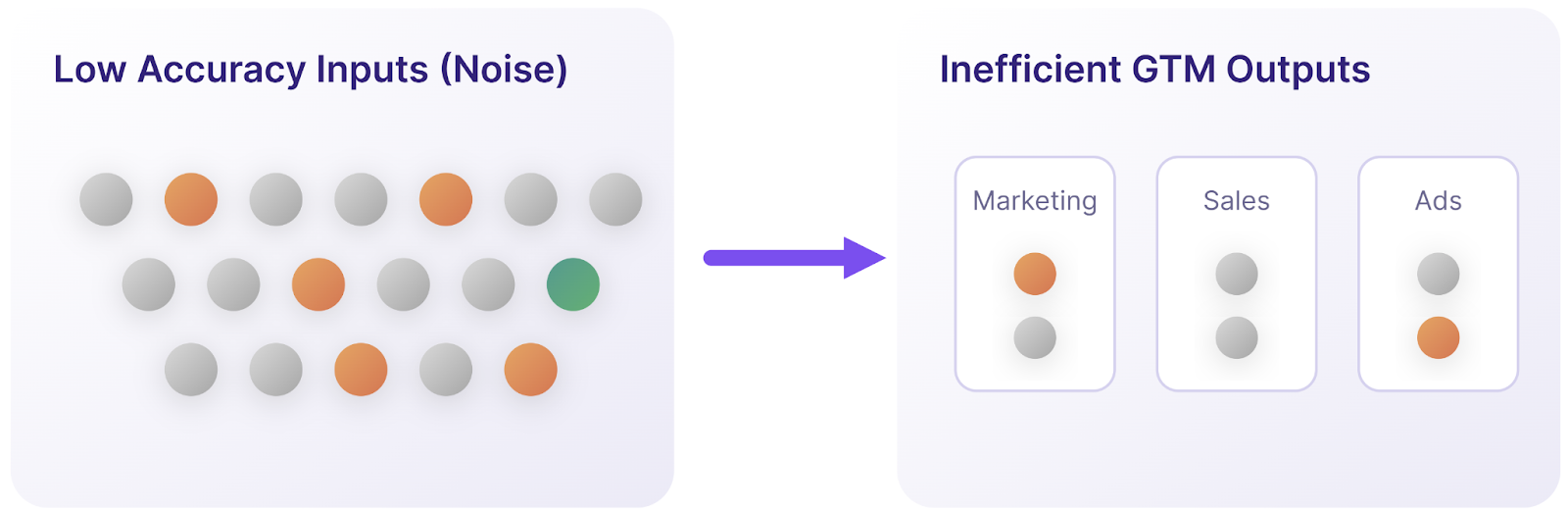
- Sales teams waste resources chasing non-buyers and get low conversions.
- AI agents amplify bad inputs at scale to create poor customer experiences.
- Marketing retargets the wrong audiences and reduces ROAS.
- Forecasts are based on inflated pipeline that misinform targets.
- Leaders make strategic decisions on faulty insights which spread from the top-down.
- Everyone misses the hidden pipeline and revenue that is being ignored right now.
Intent data was meant to accelerate efficiency but instead, it’s become a silent tax on GTM performance.
To understand why, we have to examine where these signals actually come from and why each source fails more often than it succeeds.
How the Four Major Intent Sources Get It Wrong
1. Third-Party Intent (a.k.a. In-Market Data)
Third-party intent data is gathered from external publishers, data brokers, and vendors. These systems aggregate signals like content consumption, topic-based keyword searches, firmographics, technographics, IP-level tracking, and cookie matching - then label accounts as “in-market.”
The appeal is scale and efficiency. The reality is noise.
- Vague or ambiguous signals:
A keyword search or article view doesn’t mean someone is buying. “Intent” might simply reflect curiosity, research, or competitive analysis — not purchasing readiness, budget, or authority. - Fragmented and incompatible:
These signals come from many different publishers and data streams, stitched together into one score. The quality, context, and methodology vary so widely that the composite data is rarely reliable. There’s no consistent correlation between one signal and another. - Latency and delays:
Most third-party intent data is delayed by days or weeks. By the time your SDRs receive it, the opportunity may have already passed — or never existed in the first place. - Privacy and compliance risks:
With GDPR, CCPA, and browser privacy changes, the quality and completeness of third-party data continues to degrade. Transparency is low, and the origin of many data points is unclear. - Account-level ambiguity:
You might see that “someone at Company X” is researching a topic, but not who they are or whether they influence buying decisions. That’s not actionable intelligence, it’s a guessing game.
The bottom line is that third-party intent is best used as a directional indicator. It’s useful for spotting emerging topics, very early research, or broad awareness shifts, but far too weak to serve as the foundation of a reliable GTM strategy.
2. First-Party “Activity” Signals
First-party data is typically seen as activity from your own website, CRM, and campaigns — and it’s inherently more trustworthy because you own it rather than a second- or third-party vendor.
But it’s also (typically) painfully shallow and incomplete.
Most companies only collect a handful of first-party signals: clicks, form fills, email opens, and pricing-page visits.
Those signals tell you just a tiny fragment of what someone did, but not what their complex buying behavior is.

- False positives:
A page view, form fill, or email click often gets mistaken for intent. But that activity could come from researchers, competitors, or low-intent browsers. Single actions, taken out of behavioral context, are statistically unreliable predictors of readiness to buy. - Co-occurrence bias:
Most systems assume correlation equals causation. For example “people who view pricing pages tend to convert.” But this creates false associations that inflate scores for casual visitors while ignoring the real buying signals that happen elsewhere. - The pricing-page trap:
One of the most dangerous assumptions in marketing is that pricing-page visitors are high intent. In fact, up to 94% of pricing-page visitors are not high-intent buyers, and 88% of actual buyers never hit the pricing page at all. If your GTM motions trigger off this page, you’re probably wrong nine times out of ten. - Hidden buyers:
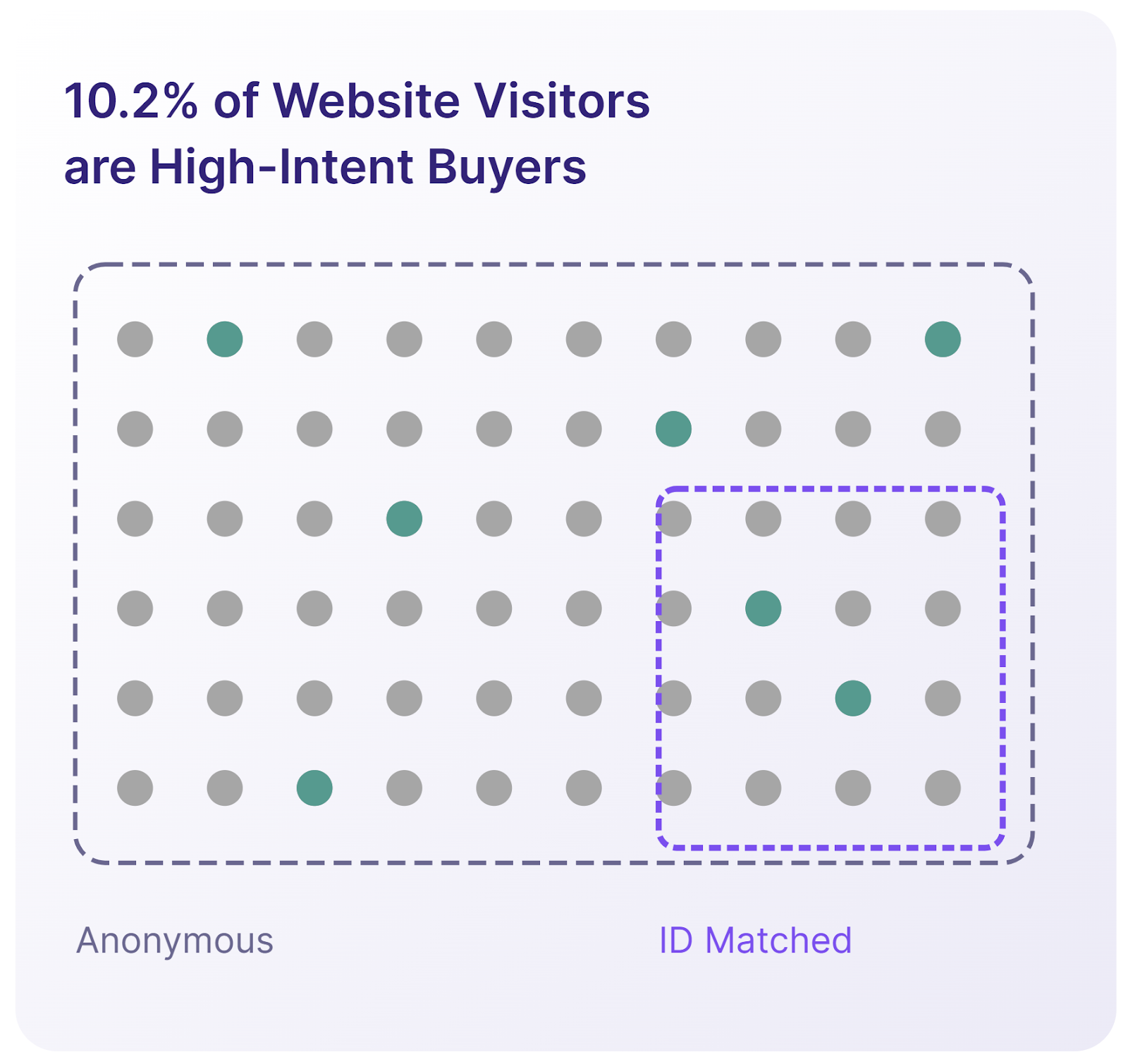
Approximately 70% of all website visitors are anonymous, but most intent tools rely on deanonymization (Account or Contact matching / reveal) in order to provide insight, missing the vast majority of hidden buyers on the website. - Messy CRM data:
Duplicate records, missing fields, and outdated enrichment mean marketing and sales often act on fragmented or misleading profiles. The result is wasted time and inconsistent follow-up.
So although first-party data is essential, it’s still subject to the inaccuracies found in other forms of intent.
3. Identity Resolution (Deanonymization)
Identity resolution and deanonymization tools promise to tell you what Accounts or Contacts are on your site. But even at their best, they can only identify about 30% of anonymous visitors, and what they reveal is who someone is, not how ready they are to buy.
A company name or email address without accurate buyer intent signals is just another data point.
Treating every deanonymized visitor as a “lead” overwhelms your sales team with false positives and wastes valuable human bandwidth. Meanwhile, automating the experience for them results in a generic experience that may miss genuine buyers.
Identity is useful for personalization, not for predicting purchase intent.
4. Form Fills and Lead Scoring
Lead scoring was meant to bring order to chaos - a simple way to prioritize leads and focus sales resources on the highest-potential buyers.
The concept was good, but the execution was flawed.
- Overweighted and blind
Models overvalue a few visible actions while ignoring hundreds of more subtle signals that high-intent visitors consistently display. - Human bias
Most lead scoring systems rely on arbitrary scores (e.g., “form fill = 10 points,” “email click = 5 points”) to make buying predictions, but these actions and scores are determined and weighted by humans who can’t help but inject bias into the equation. - Missed hidden pipeline
Lead scoring models fail to capture real buyer behavior - especially from anonymous visitors that didn’t provide their identifiable information - leaving a massive amount of true intent unseen. - Responsive, not intentional
Scoring based on ad clicks or email opens rewards reactions to marketing effort, not genuine purchase motivation.
So instead of using form fills and lead scoring to prioritize effectively, these systems misdirect GTM resources and erode confidence between marketing and sales.
Why is Nobody Talking About This?
Because it looks like it’s working.
Dashboards show engagement. Intent scores increase. Campaigns are running.
The illusion of insight has replaced the discipline of accuracy.
And most teams don’t measure or question the real performance of their intent data, they just assume it’s better than nothing.
But “better than nothing” isn’t good enough when you’re spending millions on GTM motions powered by it.
Lift AI: The 85% Antidote to the 20% Problem
Lift AI was built to fix this.
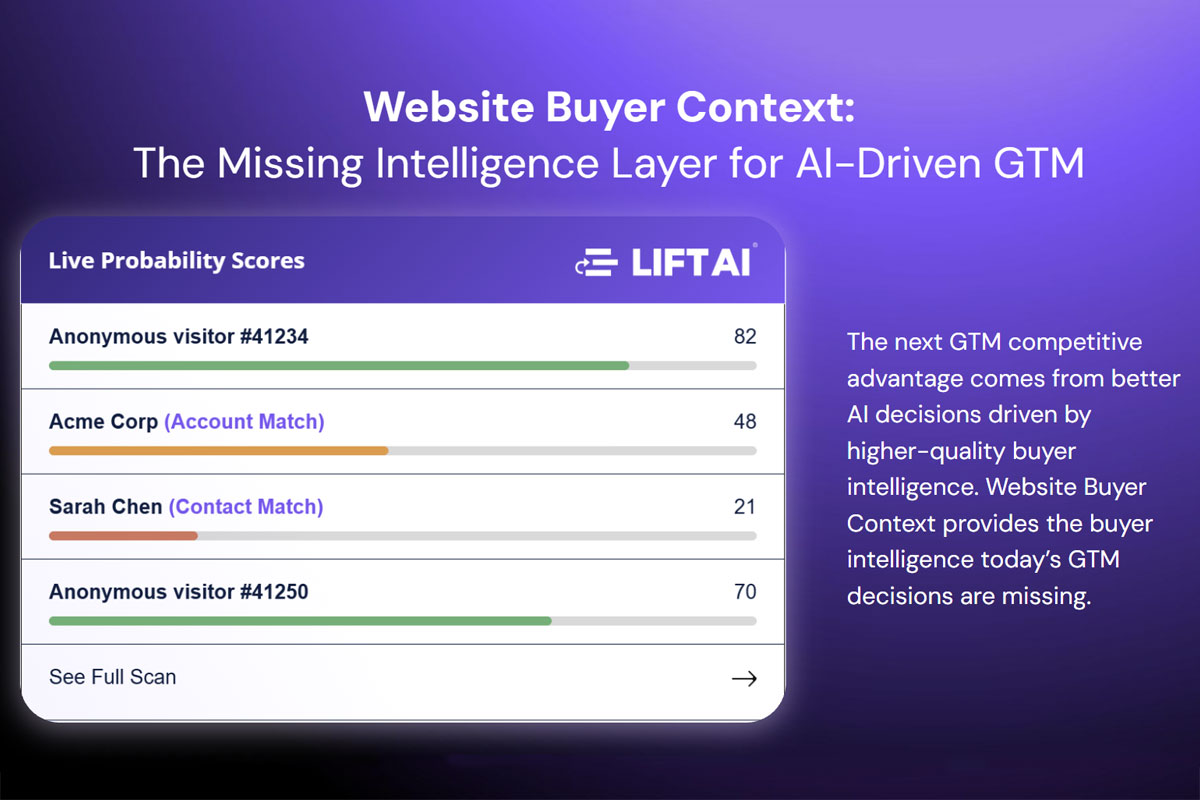
Unlike other intent sources that rely on proxies, bias, or a fragmented view of data, Lift AI uses real-time behavioral modeling to analyze hundreds of micro-signals across your website - detecting real buying intent, even from anonymous visitors.
It’s pre-trained based on billions of data points and hundreds of millions of sales transactions, captured over 15 years and across almost every industry and vertical.
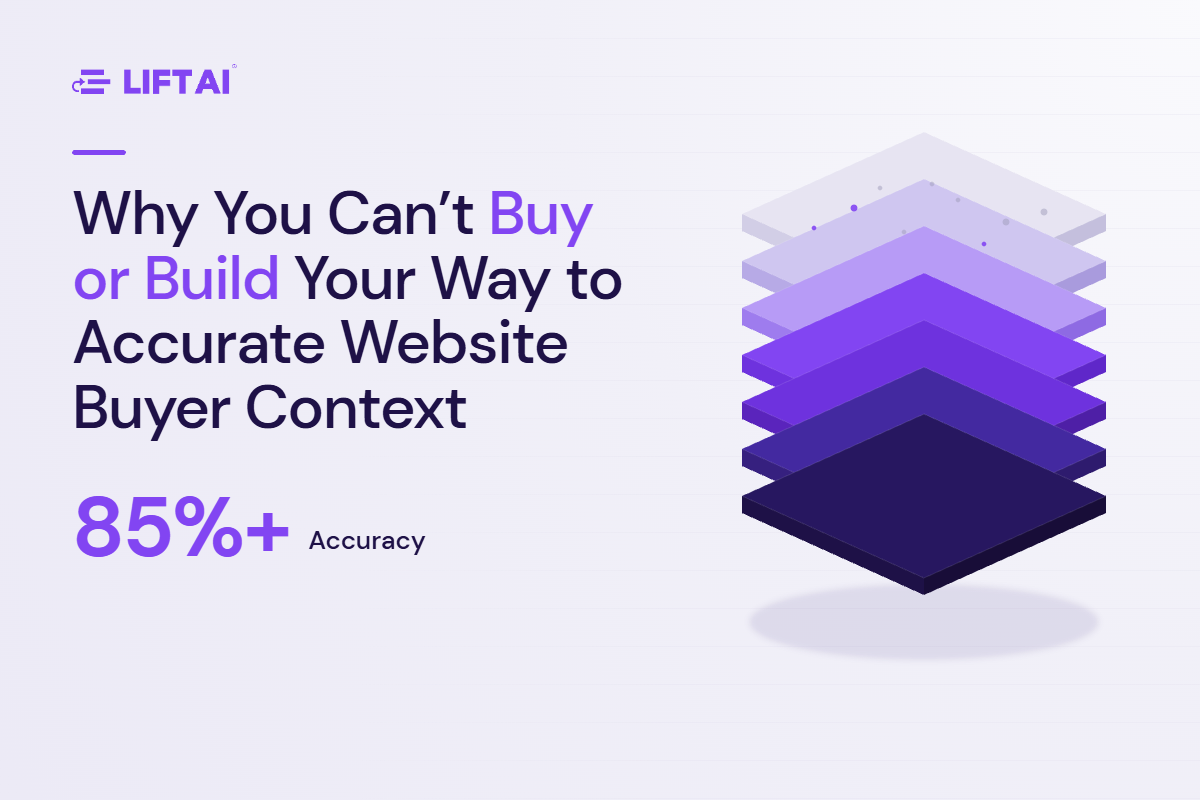
The result: accuracy rates exceeding 85% validated by leading companies like Boomi, Okta RealVNC, and Payscale.
When you replace guesswork with precision:
- Your SDRs and AE’s focus on sales-ready visitors while deflecting low-intent to automation.
- Your Conversational AI agents are used where they work best - educating, guiding, and nurturing mid- to low-intent prospects until they’re sales-ready.
- Your marketing and ad spend focuses on the audiences that are High Intent , and adjusts spend, messaging and creative for those who aren’t.
- Your forecasts start matching reality and realistic targets get set.
- Your leaders are able to make strategically-sound decisions.
- Your entire company surfaces and activates hidden pipeline being missed right now, transforming your website into a GTM revenue engine.
This is what happens when you feed your GTM engine the right fuel and fulfil the original promise of “intent” data / signals.
The Wake-Up Call to Fix Your GTM
If your intent data is only 20% accurate, you’re not optimizing your GTM - you might be sabotaging it.
It’s time to stop confusing activity for accuracy, and noise for insight.
Because the future of GTM isn’t about doing more, it’s about doing the right things, for the right buyers, at the right time.
Lift AI is how you do that.
Start your free trial now to see what 85% accuracy looks like in your pipeline (and ask about our performance guarantee).